

MultiDisc-Thermoprozessoren
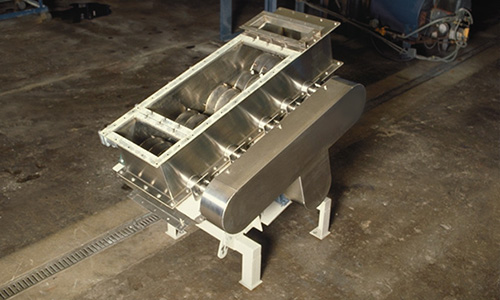
Der MultiDisc-Thermoprozessor von Heyl Patterson ist eine Niedrigtemperatur- oder Mitteltemperatur-Verarbeitungseinheit, die ein innovatives Wärmeübertragungsverfahren auf Basis von Wärmeleitung und Konvektion nutzt, um Schüttgüter wie Mineralien, Chemikalien, Pigmente, Böden und Schlämme indirekt zu trocknen und/oder zu kühlen. Die indirekte Verarbeitung bietet erhebliche Vorteile, wie beispielsweise ein höheres Verhältnis von Produkt zu Oberfläche, eine sehr hohe thermische Effizienz und minimale Abgasmengen, wodurch kostspielige Luftreinhaltungsanlagen überflüssig werden. Unser MultiDisc-Thermoprozessor zeichnet sich durch ein innovatives Design aus, das Oberflächenverschmutzungen, Verstopfungen und den Stromverbrauch weiter reduziert und so Ihre Gesamtbetriebskosten effektiv senkt.
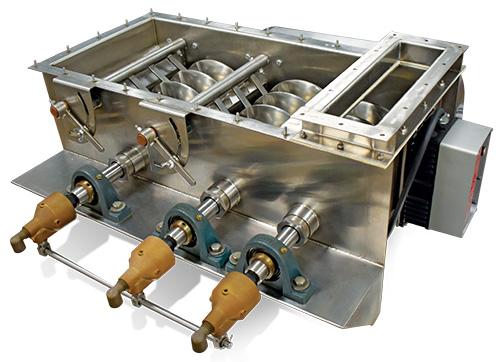
Konfigurierbar mit Maschenscheiben, Nicht-Maschenscheiben oder einer Kombination aus beiden. Maschenscheiben sorgen für eine verbesserte Durchmischung von schwer zu transportierenden feuchten Feststoffen oder solchen, die an heißen Oberflächen haften, und eignen sich ideal für die Chargenverarbeitung, bei der eine gleichmäßige Temperaturregelung erforderlich ist.
Merkmale und Vorteile
- Ein hohes Produkt-Oberflächen-Verhältnis verbessert die Wärmeübertragungseffizienz.
- Die indirekte Verarbeitung erzeugt nur minimale Abgasmengen.
- Das vielseitige Design ermöglicht die Zirkulation von Wärmeträgerflüssigkeiten in parallelen Strömungsmustern.
- Abgewinkelte Förderstangen verhindern ein Überlaufen oder Kurzschließen an den Seitenwänden.
- Die kompakte Größe bietet die gesamte Verarbeitungskapazität auf einer Fläche, die kaum Platz für den Antriebsstrang ähnlicher thermischer Prozessoren bietet.
- Landwirtschaft/Getreide
- Gips
- Organische Chemikalien
- Keramik
- Kohle
- Metalle
- Pigmente
- Polyester
- Soda
- Bergbau & Mineralien
Heyl Patterson MultiDisc-Thermoprozessoren werden für unzählige Trocknungs-, Heiz- und Kühlungsanwendungen empfohlen. Laden Sie unsere Broschüre zu MultiDisc-Thermoprozessoren herunter, um weitere Anwendungsbereiche zu entdecken.
Hohes Verhältnis von Fläche zu Volumen bei der Verarbeitung
Konstruktion einer Hohlscheiben- und Wellenbaugruppe
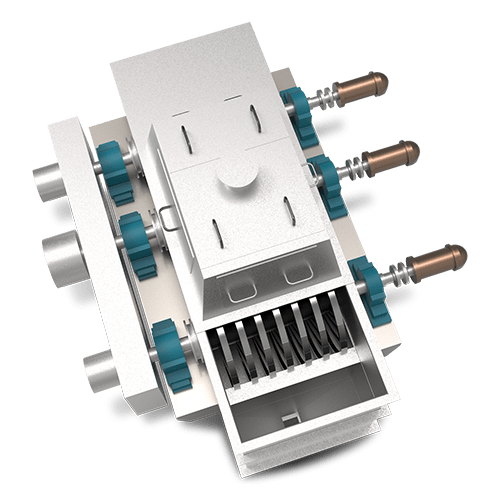
Mehrere Scheiben sind fest mit der Welle verbunden, um eine feste, abgedichtete, in sich geschlossene Einheit zu bilden. Kühlwasser, Dampf, Wärmeträgerflüssigkeit oder Kältemittel zirkulieren durch die hohle Baugruppe und übertragen Wärme oder Kälte auf die rotierenden Scheibenoberflächen.

Das Produkt fließt zwischen und um die Scheiben in der Mulde herum und ist dadurch einer sehr großen Scheibenoberfläche in einem relativ kleinen Behälter ausgesetzt, was zu einer verbesserten Effizienz führt.
Indirekte Erwärmung bietet ein höheres Verhältnis von Produkt zu Oberfläche für eine verbesserte thermische Effizienz. Sie verbraucht nur minimale Abgasmengen, wodurch weniger kostspielige Luftreinhaltungsanlagen oder Systeme zur Rückgewinnung flüchtiger Stoffe erforderlich sind. Inerte, oxidierende, reduzierende und entfeuchtende Prozessatmosphären können aufrechterhalten werden. Und feine Materialien lassen sich leicht verarbeiten, ohne dass es zu einer übermäßigen Mitführung des Produkts im Gasstrom kommt.
Jede Heyl Patterson MultiDisc wird nach Ihren individuellen Vorgaben gefertigt oder von unseren Ingenieuren so konstruiert, dass sie Ihre spezifischen Anwendungsanforderungen übertrifft. Vor der Umsetzung des endgültigen Designs kann jede MultiDisc in unserem Innovationszentrum und Testlabor strengen Pilotversuchen unterzogen werden.
Sprechen Sie mit einem Experten.
Optionen & Zubehör
- Gitterförmige oder nicht gitterförmige Scheibenbaugruppen
- Dampf-, Wärmeübertragungs-, Fluid- oder Stromversorgungssysteme
- Kreislaufsysteme
- Rührer-Clips & Breaker-Stangen
- Elektrisches Heizelement
- Steuerungssysteme
Downloads

What is a MultiDisc Thermal Processor?
The Heyl Patterson MultiDisc Thermal Processor is an indirect, low- to medium-temperature processing unit that uses a combination of conduction and convection heat transfer to dry, heat, or cool bulk solids. It delivers precise, energy-efficient thermal treatment in a compact footprint, making it well-suited for materials that cannot tolerate direct contact with a heat source or where minimizing exhaust gas volume is a process or environmental priority.
So funktioniert es
The Heyl Patterson MultiDisc Thermal Processor uses a hollow disc-and-shaft assembly to transfer thermal energy indirectly to the material moving through the trough. It is engineered around four integrated principles that work together to give processors controlled, efficient thermal treatment across a wide range of bulk solid materials:
Hohlscheiben- und Wellenbaugruppe
Multiple hollow discs are permanently attached to a hollow rotating shaft, forming a single sealed, self-contained assembly. A heat transfer medium, either steam, thermal fluid, hot water, chilled fluid, or electric heating elements, circulates through the shaft and into the discs, transferring thermal energy directly to the rotating disc surfaces. Because the heat source is fully contained within the assembly and never contacts the product directly, the system achieves true indirect processing with no combustion gases introduced into the material stream.
High Surface Area to Volume Ratio
As material flows through the trough, it moves between and around the rotating disc surfaces, exposing each particle to a large amount of heated or cooled surface area within a relatively small vessel. This geometry is the MultiDisc design’s core efficiency advantage: it packs significantly more heat-transfer surface area into a given footprint than conventional jacketed or single-shaft processors. The result is faster thermal treatment at lower operating temperatures, with less energy consumed per unit of material processed.
Controlled Material Flow & Mixing
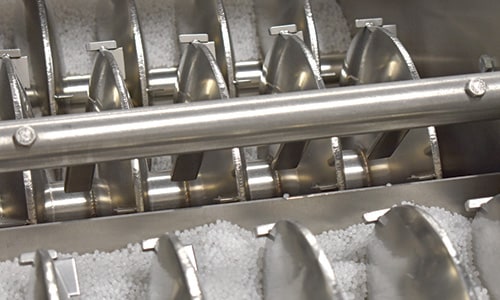
Angled conveying bars move material through the trough in a controlled pattern, preventing short-circuiting or bypassing along the sidewalls. For sticky, cohesive, or surface-fouling materials, meshed disc configurations provide enhanced mechanical mixing that breaks up agglomerates and keeps material in consistent contact with the disc surfaces. You can add agitation clips and breaker bars where you need additional mechanical action. This flexibility in disc configuration allows the same basic design to handle materials ranging from free-flowing granules to wet filter cakes and sludges.
Atmosphere & Exhaust Control
Because processing occurs indirectly, exhaust gas volume is minimal compared to direct-fired systems. The enclosed trough can maintain inert, oxidizing, reducing, or dehumidifying process atmospheres depending on the material requirements, and the low exhaust volumes simplify or reduce the cost of downstream air pollution control and volatile recovery systems. This makes the MultiDisc particularly well-suited for processing chemicals, pigments, and other materials where atmospheric control or emissions management is a design constraint.
Key Benefit
This design is well-suited for drying, heating, or cooling bulk solids including minerals, chemicals, pigments, agricultural products, gypsum, soda ash, and industrial sludges, where precise temperature control, minimal exhaust gas generation, indirect heat transfer, and a compact system footprint are critical to process performance and operating economics.
Processors (MultiDisc & Specialized Systems) FAQs
What materials are best suited for MultiDisc thermal processors?
MultiDisc processors excel with bulk solids that benefit from indirect conduction/convection heat transfer, including chemicals, minerals, agglomerates, and heat-sensitive products.
How does a MultiDisc processor differ from a traditional rotary dryer?
MultiDisc processors use stacked discs to increase surface area for heat transfer without moving belts or screws, enabling more compact designs and tighter temperature control.
Can these processors handle sticky or cohesive materials?
Yes, configurations with meshed discs or gentle agitation promote uniform heat transfer and prevent buildup in sticky or challenging materials.
Are MultiDisc processors suitable for both drying and cooling?
Yes, depending on the configuration and heat-transfer medium (steam, thermal fluid, electricity, chilled fluid), processors can be optimized for either drying or cooling.
What operational benefits do these systems provide?
Advantages include lower exhaust-gas volumes, lower air-pollution-control costs, a compact footprint, and more responsive temperature control than some conventional dryers.
How do I determine whether a processor is more cost-effective than a traditional dryer for my process?
A process evaluation, including moisture content, temperature goals, and energy cost modeling, will identify where a processor’s conduction/convection design yields savings in energy, footprint, or maintenance.
Featured Industries
Bergbau & Mineralien
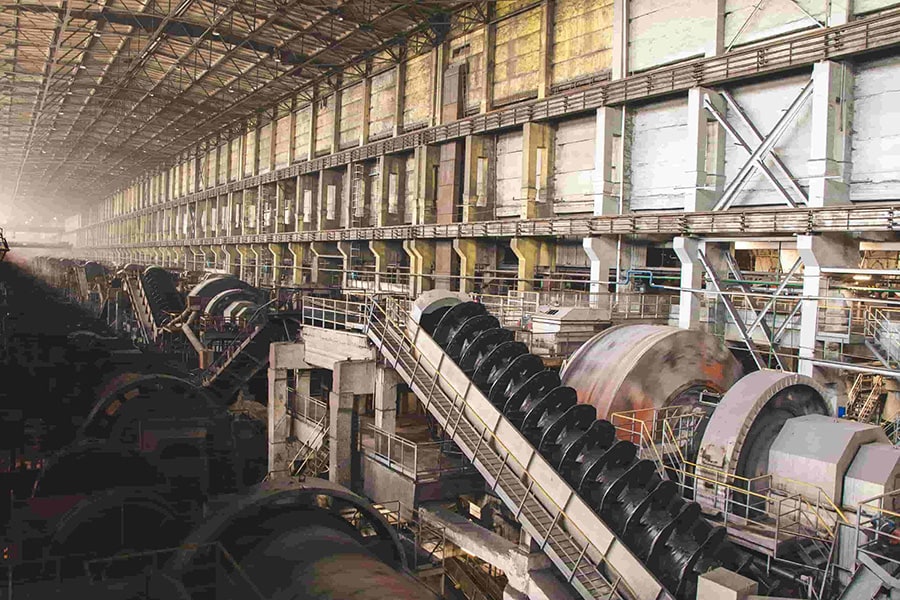
MultiDisc processors handle bulk mineral materials requiring gentle indirect thermal treatment, delivering uniform heating or drying across a wide range of particle sizes with low energy consumption and a compact system footprint.
Chemische Verarbeitung

The MultiDisc Thermal Processor dries, heats, or cools specialty chemical materials through indirect conduction, maintaining precise temperature control with minimal exhaust gas generation, making it well-suited for regulated or atmosphere-sensitive chemical processing applications.
Kohle und Flugasche
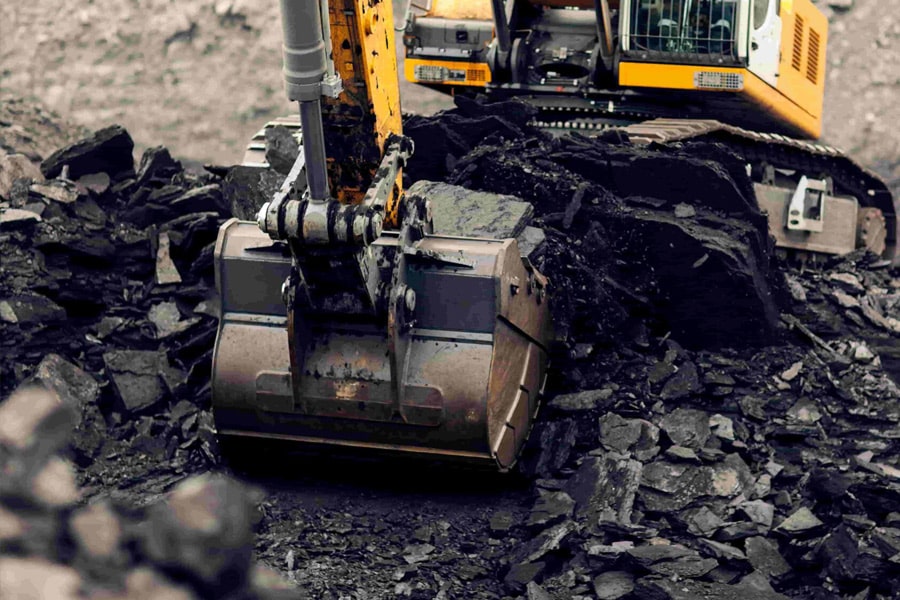
Heyl Patterson MultiDisc processors apply indirect thermal treatment to coal byproducts and fly ash, providing controlled heating or drying with minimal exhaust volume and atmosphere containment suited to regulated industrial processing environments.