
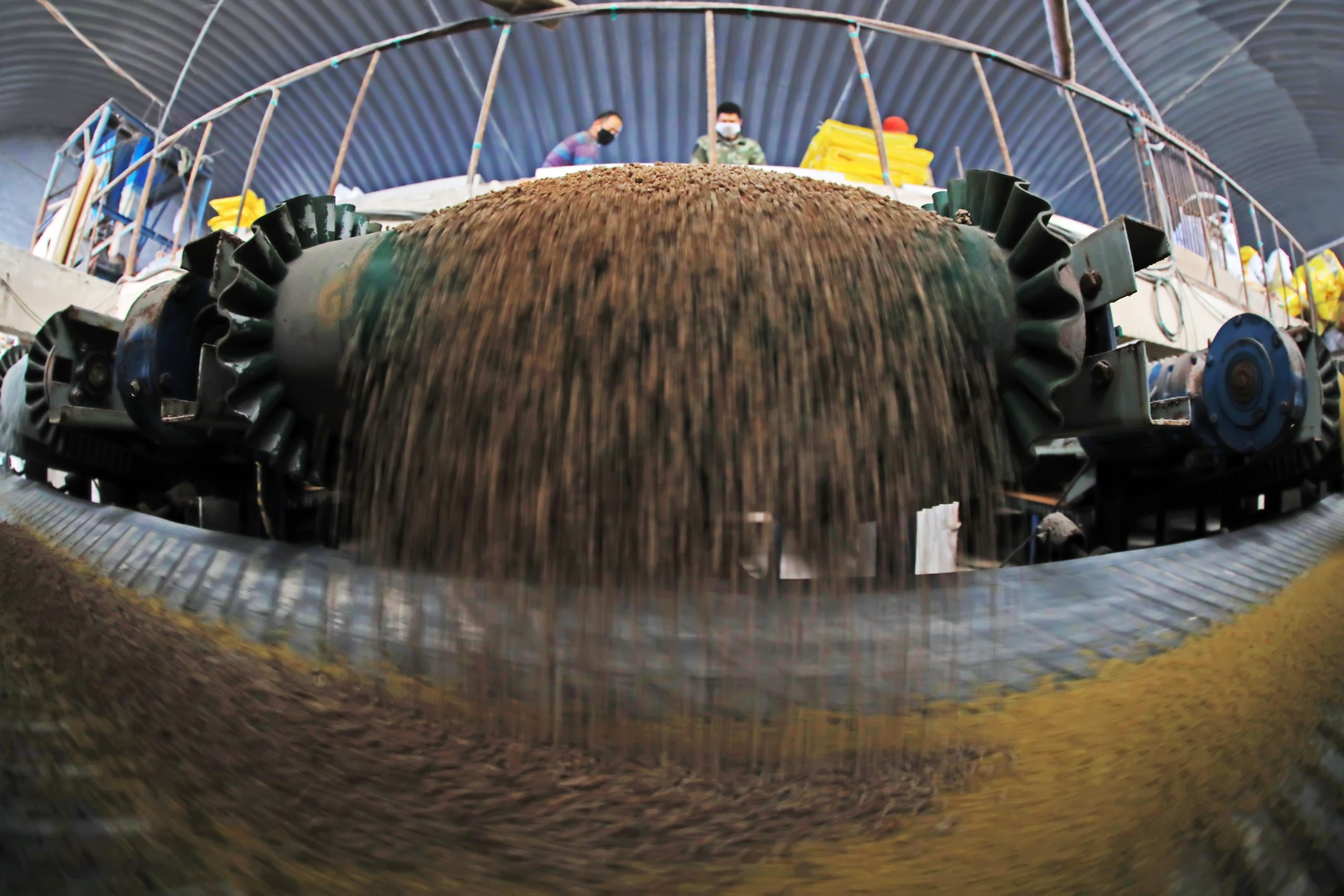
Agglomerators, also known as agglomeration drums, heap leaching drums, or ore drums, are used in the mining industry. These machines cause particles to clump together into larger particles, making metals within slurries easier to remove in a process known as chemical precipitation. Though integral for the removal of ore, agglomerators are also used for treating wastewater, controlling pollution, and other material processing applications.
How Agglomerators Handle Sticky, Fine & Dusty Materials
Using a binding agent, the rotating drum of an agglomerator causes finer materials to stick together and gather up other fine particles within a material. This agglomerates finer powders into a uniform mixture, reducing dust and minimizing waste. Once gathered into bulkier granules, the material flows better to optimize handling, shipping, and storage.
Agglomerators also augment product quality and consistency by processing particles into more consistent shapes and sizes. This is vital for the pharmaceutical sector, where precision is necessary to control the release of medicines. Agglomerators also make materials disperse more evenly and dissolve more readily in liquids, which improves nutrient delivery in fertilizers by improving their solubility.
Agglomerator Applications
Numerous industries make use of an agglomerator when processing bulk materials. These versatile machines help form pellets or granules from finer powders.
Applications where agglomerators are often used include:
- Agriculture: For fertilizers, granules are formed from powdered nutrients to reduce dust, mitigate contamination and enhance the efficiency of nutrients within the soil.
- Chemicals: Additives, catalysts, pigments, resins and other chemical-based ingredients are made safer for downstream industrial processes in the petrochemical and chemical processing sectors, while also optimizing efficiency and ensuring consistency in chemical reactions.
- Food processing: Agglomerators improve the solubility of powdered food products by dispersing dried milk, instant coffee, nutritional supplements, and other ingredients.
- Mining: Agglomerators are most commonly used to process ores and other valuable minerals in mining operations, by forming them into pellets to enhance material handling, optimize extraction, and reduce dust.
- Pharmaceuticals: Agglomerators make it easier to compress materials into tablets, controlling how active ingredients disperse through the body, and augmenting precision in dosing.
- Waste management: When processing waste, agglomerators pelletize powdered waste to make it more manageable, augmenting handling during recycling or disposal operations. Frequently, fly ash from coal-generating power plants is converted into construction materials using agglomerators.
Agglomerators can also be used to produce biofuels, beverages, food, and other products where solubility and dispersion are necessary.
Heyl Patterson Agglomerators
Heyl Patterson Thermal Processing designs both fluid bed and rotary agglomerators for granulating bulk powders into pellets and granules. Our fluid bed agglomerators spray feed material when wet onto a bed where drying is combined with agglomeration. Heyl Patterson’s rotary drum agglomerators use tailored drums to provide material with longer or shorter processing times to control particle size via inclination and speed of rotation.
Heyl Patterson’s agglomerators work well for processing materials that include:
- Calcium chloride
- Fertilizers
- Metallic ores like copper and gold
- Zinc sulfate
To learn more about our agglomerators, contact Heyl Patterson today.
Last updated on December 18th, 2025 at 03:53 pm