
Introduction: What is a Mineral Processing Plant?
Beyond digging rocks from the ground, the crucial next step in mining is mineral processing. These vital industrial plants take raw ore from the mine and transform it into usable materials.
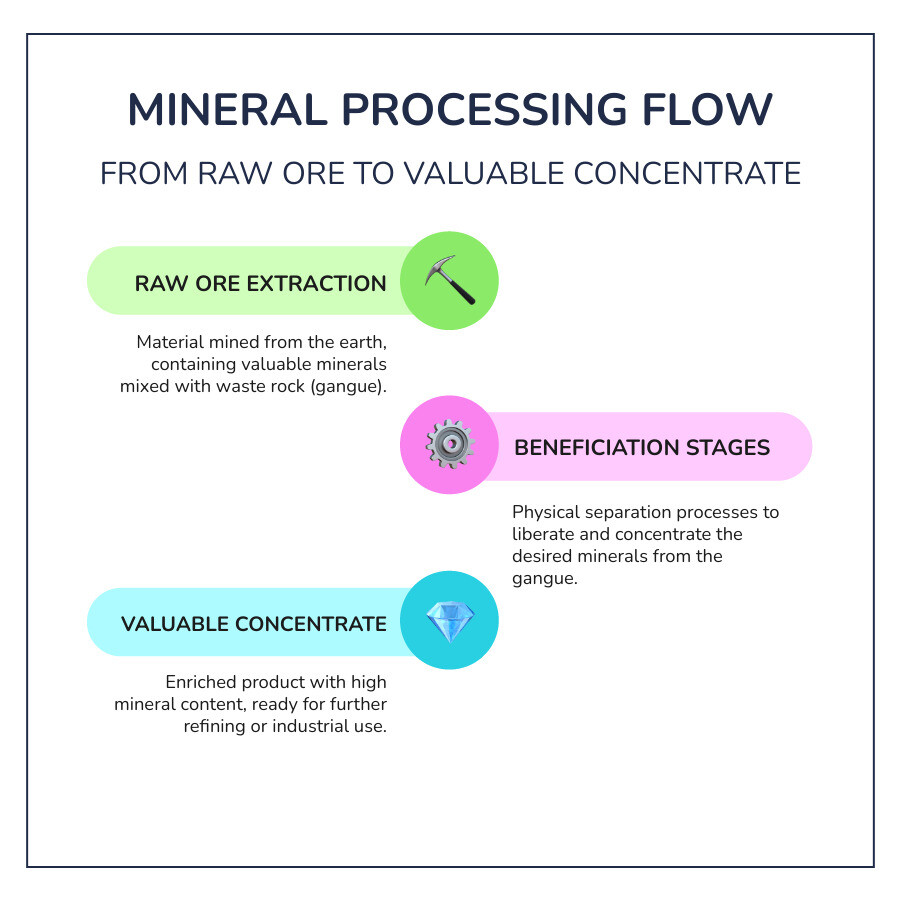
- Primary Purpose: To separate valuable minerals from waste rock (also called gangue).
- Goal: To create a concentrated product (ore concentrate) for further industrial use or refining.
- Why it Matters: This process, often called beneficiation, greatly boosts the economic value of the raw material.
The process is like sifting for gold: isolating small, high-value parts from a large volume of low-value material. Mineral processing plants handle a wide variety of materials, including:
- Gold
- Iron
- Copper
- Lithium
- Sand
- Coal
- Limestone
These plants are an essential link between extracting raw ore and the advanced stages of metallurgy or chemical engineering. Without them, most raw materials wouldn’t be ready for our modern world.
The Core Process: Main Stages of Mineral Processing
Turning raw ore into a valuable concentrate is a complex sequence of operations called a flowsheet, the plant’s recipe for success. The process revolves around two goals: mineral liberation (freeing valuable minerals from waste rock) and achieving a high recovery percentage (capturing as much of the valuable material as possible). Each stage, or unit operation, performs a specific job.
Mineral processing plants are designed around these core stages. Our work in Mining & Minerals processing has taught us how critical each step is to the overall success of the operation.
Stage 1: Comminution (Size Reduction)
Raw ore, sometimes in boulders the size of cars, can’t be shipped to a refinery. It must first be broken down through comminution. This stage, which involves crushing and grinding rock into finer particles, is the most energy-intensive part of the operation.

Crushing happens first. Large chunks of ore are fed into powerful jaw crushers, which can reduce ore to less than 150 millimeters. Then, cone crushers take over for secondary and tertiary stages, getting the pieces down to 10-15 millimeters. Most crushing happens dry. You can find More info about Crushing if you’re curious about the mechanics.
After crushing, the ore is still too coarse for efficient separation, so grinding is next. Large rotating drums called mills reduce the ore to a fine powder or slurry. Ball mills use steel or ceramic balls to pulverize the ore. SAG mills (semiautogenous grinding mills) let the ore mostly grind itself, with a small percentage of grinding balls to assist.
The goal of particle size reduction is to find the sweet spot: particles fine enough to free the valuable minerals, but not so fine that separation becomes difficult or energy costs spiral.
Stage 2: Sizing and Classification
After comminution, the mixed-size ore must be sorted, as different separation techniques require specific particle sizes.
Screening is the most direct approach. Vibrating screens with precise openings act like giant sieves, separating material into “undersize” and “oversize” fractions.
For finer particles in a wet slurry, classification is used. Hydrocyclones are the workhorses here, using centrifugal force to separate particles by size and density. Larger, heavier particles are thrown to the outside and discharged at the bottom, while finer particles exit through the top.
This material grading step is essential. Sending the wrong particle size to a separation process causes efficiency to plummet.
Stage 3: Concentration (Separation)
This is the heart of the operation, where valuable minerals are finally separated from waste. Concentration exploits the different properties of various minerals.
Gravity separation is one of the oldest methods. Heavy minerals sink faster than light ones. Shaking tables and spiral concentrators use this principle to concentrate heavy materials. Modern methods can even handle very fine particles, as detailed in Gravity Separation: Old Technique/New Methods.
Froth flotation is the workhorse of modern mineral processing. It’s based on surface chemistry. By adding specific chemicals and air bubbles to a slurry, valuable minerals are made to stick to the bubbles and float to the surface as a froth, which is then skimmed off.
When minerals have magnetic separation properties, powerful magnets pull them away from non-magnetic materials. Electrostatic separation uses electrical conductivity differences to separate particles, which deflect differently in an electric field. This technique typically works best with dry particles.
The result is a concentrate with a much higher grade and purity.
Stage 4: Dewatering and Drying
The resulting concentrate is a wet slurry that must be dewatered before shipping or further processing. This moisture removal is a multi-step process.
Thickening is the first step. Large tanks use gravity to let solids settle, increasing the pulp density. The clear water on top is recycled back into the plant.
Filtration comes next. Vacuum or pressure filters squeeze out more water, producing a much drier filter cake.
For concentrates that need to be exceptionally dry, thermal drying is required. This is where our expertise at Heyl Patterson makes a difference, as we design and build high-efficiency equipment for this task.
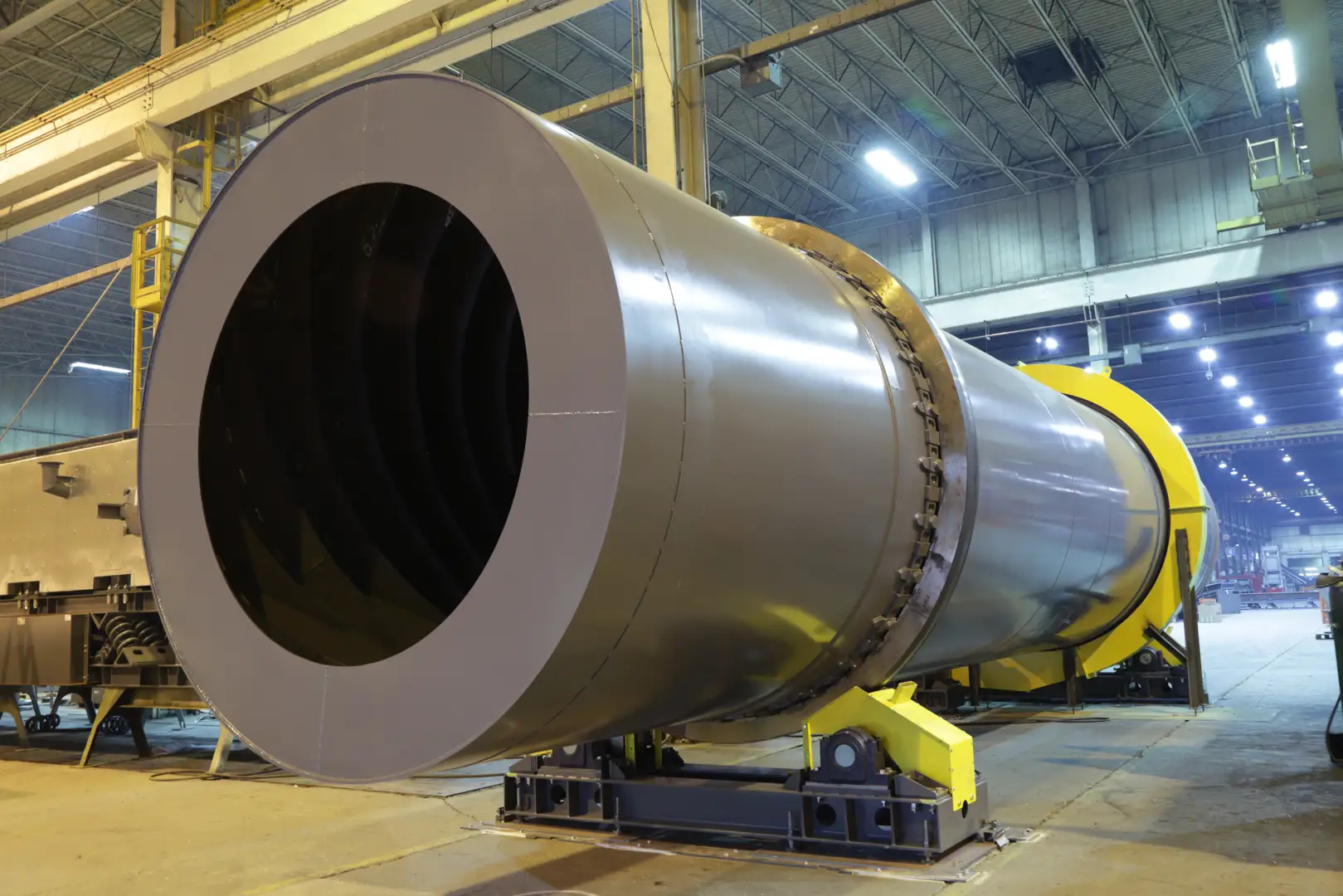
Our Rotary Dryers & Coolers are versatile workhorses that tumble material through a rotating cylinder while hot air evaporates moisture, handling a wide range of mineral concentrates.
For finer or heat-sensitive materials, our Fluid Bed Dryers & Coolers offer excellent heat and mass transfer by suspending particles in a stream of hot gas for rapid, uniform drying.
We also manufacture Flash Dryers for instant powder drying and Calciners for high-temperature thermal processing. Proper drying reduces transportation costs and ensures the material meets the exact specifications required by downstream processes.
Designing and Operating Modern Mineral Processing Plants
A successful mineral processing plant requires careful orchestration of science, engineering, and economics, starting with a thorough feasibility study. This study assesses ore characteristics, market demand, regulations, and financial viability. Once a project moves forward, the focus shifts to process optimization to maximize plant efficiency and throughput while controlling operational costs.
Key Design Considerations for Mineral Processing Plants
Designing a new plant or improving an existing one starts with asking the right questions.
Ore mineralogy is the foundation. The type, hardness, and composition of the ore dictate the entire process, from comminution strategy to separation techniques and chemical reagents.
Next, we examine feed characteristics like moisture content, particle size distribution, and potential contaminants. These factors directly influence equipment selection and operational parameters.
Water availability is increasingly critical. Many operations require substantial water, so in arid regions, water recycling and efficient use are essential design elements.
Energy costs are a major concern, as comminution alone can consume over half of a plant’s total energy. Plant design must prioritize energy efficiency at every step.
The capital expenditure is substantial. We help clients balance initial costs with long-term operational efficiency. A higher initial investment in quality equipment often pays for itself through reduced maintenance and better performance. We offer flexible solutions, including skid-mounted plants and larger, relocatable designs.
Environmental permitting is a fundamental requirement, covering air emissions, water discharge, and solid waste. We integrate environmental compliance into our designs to meet or exceed regulations.
To reduce risk, our Test Lab allows us to analyze your material and simulate processing conditions before you commit to full-scale equipment. This approach helps clients avoid costly mistakes and improve their return on investment.
Overcoming Key Operational Challenges
Even the best-designed mineral processing plants face ongoing challenges.
Declining ore grades are a pressing issue. As rich deposits are depleted, plants must process more material with greater efficiency to extract the same amount of valuable mineral, intensifying cost pressures.
Water scarcity forces operations to implement advanced water recycling, explore dry processing alternatives, and invest in more efficient dewatering technologies.
High energy consumption contributes to operating costs and carbon footprint. Optimizing energy use is an ongoing challenge that requires constant innovation.
Tailings management is a critical and potentially risky aspect. These waste products must be safely stored. Dry stack tailings are a more environmentally sound alternative to traditional dams, often requiring effective dewatering and drying technologies.
Equipment maintenance is a constant reality. Routine maintenance prevents breakdowns, but unplanned shutdowns are extraordinarily costly. We build equipment with quality and reliability at its core to help you avoid these issues.
Material handling can also create bottlenecks, especially with sticky or difficult materials. We’ve found that agglomeration techniques can often solve these problems. For more guidance, our white paper on Averting Powder & Bulk Solids Processing & Handling Issues offers practical insights.
Navigating these challenges requires continuous innovation, smart engineering, and reliable equipment.
Essential Machinery for Mineral Processing Plants
The heart of any mineral processing plant is its machinery. While every plant is customized, certain equipment types are fundamental.
Crushing equipment like jaw crushers, cone crushers, or impact crushers handles the initial size reduction.
Grinding mills such as ball, rod, and SAG mills reduce material to the fine particle sizes needed for mineral liberation.
Separation equipment isolates valuable minerals. This includes flotation cells, magnetic separators, and gravity concentrators like shaking tables and spiral concentrators.
Dewatering equipment like thickeners and filters removes bulk water from concentrates and tailings.
This is where our expertise at Heyl Patterson comes into focus. Drying equipment removes residual moisture to meet product specifications. Our Rotary Dryers and Coolers handle a wide range of mineral concentrates. Our Fluid Bed Dryers and Coolers offer rapid, uniform drying, which is particularly effective for fine or heat-sensitive materials.
For materials requiring high-temperature treatment, calciners are essential. Our Fluid Bed Calciners and rotary calciners provide the controlled environment needed for these applications. You can learn more about What Are Different Types of Thermal Processing Equipment? on our blog.
Our thermal processing equipment is critical for the final stages that prepare your concentrate for market. We focus our engineering on building robust, high-efficiency dryers, coolers, and calciners that perform reliably in demanding applications.
Heyl Patterson is part of a group of highly skilled and experienced companies under the Carrier Process Equipment Group or CPEG. The CPEG companies provide robust industrial process equipment that help form complete integrated solutions for mineral processing lines. This one-stop shopping approach gives our clients a more comprehensive guarantee and peace of mind that the entire process will work.
The Future of Mineral Processing
The world of mineral processing plants is changing, driven by climbing global demand and growing environmental awareness. The industry is pushing toward smarter operations, cleaner practices, and breakthrough technologies.
Economic Value and Sustainability
Mineral processing plants create tremendous economic value by changing low-value ore into concentrates that power our modern world. In the United States alone, nearly 2,000 such plants produce everything from copper and gold to limestone and salt, forming the backbone of countless industries.
Economic success and environmental responsibility are increasingly intertwined. Modern plants are proving you can be both profitable and sustainable.
Forward-thinking operations focus on value-added products and get creative with waste stream recycling, recovering components that were previously discarded. Water recirculation through closed-loop systems dramatically reduces fresh water intake and minimizes discharge, which is crucial in arid regions.
One of the most significant shifts is the move toward dry stack tailings. Instead of using traditional wet tailings ponds, this method involves dewatering tailings and storing them as a stable, compacted material. It’s a safer, more environmentally sound alternative that is gaining momentum.
These efforts contribute to a reduced environmental footprint. At Heyl Patterson, our high-efficiency dryers and calciners directly support these sustainability goals by optimizing energy use and enabling better waste management practices, including preparing materials for dry stacking.
Frequently Asked Questions about Mineral Processing
You’ve made it this far, which means you’re genuinely curious about how mineral processing plants work. Let’s tackle the most common questions.
What is the difference between mineral processing and extractive metallurgy?
This is an important distinction. Think of it this way: mineral processing is the physical preparation of the ore, while extractive metallurgy is the chemical extraction of the final metal.
Mineral processing (also called beneficiation) is primarily mechanical. It involves crushing, grinding, and separating valuable minerals from waste rock (gangue) to create a concentrate. The chemical composition of the minerals is not changed.
Extractive metallurgy comes after. This is where chemistry takes over, using processes like smelting (heat and chemical agents), leaching (chemical solutions), and electrowinning (electricity) to extract the pure metal from the mineral concentrate.
In short: mineral processing concentrates the ore, while extractive metallurgy refines it into pure metal.
How much energy does a mineral processing plant use?
Energy consumption in a mineral processing plant is substantial and represents a major operational cost. The exact amount varies widely depending on the ore type, process complexity, and final product specifications.
Comminution, the crushing and grinding stage is the absolute energy hog. It often accounts for more than 50% of a plant’s total energy consumption, and sometimes as high as 70%. Breaking down hard rock into fine particles requires an enormous amount of work.
Other stages like pumping slurries, running flotation cells, and thermal drying also contribute, but comminution dominates. This is why optimizing energy use is so critical. Our thermal processing equipment, including our high-efficiency rotary dryers, fluid bed dryers, and calciners, is engineered to minimize energy consumption in the drying and thermal treatment stages, which translates directly into lower operational costs and a smaller carbon footprint.
Conclusion: Partnering for a More Efficient Future
We’ve journeyed through mineral processing plants, from the roar of crushers to the delicate chemistry of flotation. These facilities showcase a remarkable intersection of geology and engineering, changing what nature has hidden into the materials that build our modern world.
The importance of these plants cannot be overstated. They are the invisible backbone of countless industries, ensuring we have the copper, lithium, iron, and rare earth elements for everything from smartphones to the green energy revolution.
The industry never stands still. Continuous innovation is making mineral processing plants smarter, cleaner, and more efficient through AI, water recycling, and safer tailings management.
In this demanding sector, reliable, high-efficiency equipment is critical for both profitability and sustainability. Equipment failure leads to costly downtime, while inefficient thermal processing wastes energy and money. This is where a true partnership matters.
At Heyl Patterson, we’ve built our reputation on engineering thermal processing solutions that excel. Our advanced dryers, coolers, and calciners are designed for the punishing conditions of mineral processing, delivering consistent performance. But we’re more than equipment manufacturers; we’re problem solvers. Our state-of-the-art testing laboratory allows us to analyze your materials and design custom solutions, dramatically reducing risk and ensuring your investment delivers real results.
We understand the challenges you face declining ore grades, rising energy costs, and tightening environmental regulations. We are committed to helping you solve them.
Whether you’re designing a new facility, optimizing an existing one, or upgrading equipment, we’re here to support you with the expertise and technology you need to succeed. We partner with you for the long haul, ensuring your operations remain productive, efficient, and sustainable.
Ready to take the next step? We invite you to explore our advanced solutions for the Mining & Minerals industry and find how Heyl Patterson can help you build a more efficient future.