
Turning Industrial Waste into Valuable Resources
A fly ash dryer plant is an industrial facility that processes coal combustion residuals (fly ash) by removing moisture to create a valuable construction material. These plants use rotary dryers, fluid bed systems, or flash dryers operating at 200-600°C to reduce moisture content from over 20% down to less than 1%. Be sure to follow Heyl Patterson on how to de-carbonize the fly ash after it is dried, a highly important step in creating a more valuable end product.
Key Components of a Fly Ash Dryer Plant:
- Feeding System – Hoppers and conveyors for material input
- Drying Equipment – Rotary, fluid bed, or flash dryers
- Heat Source – Coal, biomass, or gas-fired systems
- Dust Collection – Baghouse filters and cyclone separators
- Control Systems – Temperature and moisture monitoring
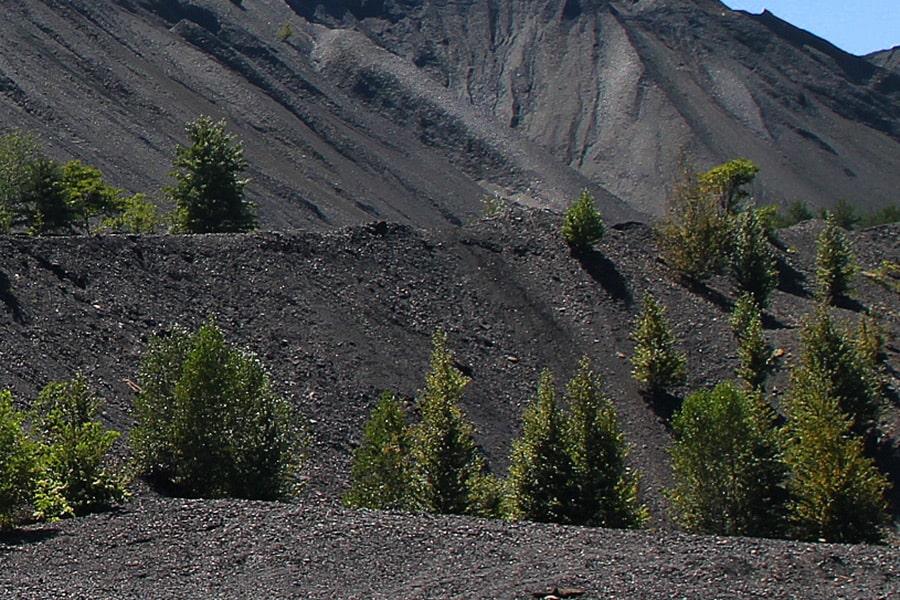
Coal-fired power plants generate millions of tons of fly ash annually. For decades, this fine gray powder was viewed as waste, with much of it ending up in landfills and ash ponds, creating serious environmental problems. According to the U.S. Environmental Protection Agency, proper management and reuse are critical.
The cement industry accounts for nearly 7% of global CO2 emissions. Meanwhile, fly ash sits unused despite having excellent pozzolanic properties that make it an ideal cement substitute. This waste-to-resource challenge is exactly what modern fly ash dryer plants solve.
Fly ash beneficiation transforms this industrial byproduct into a consistent, high-quality material. The drying process removes excess moisture, making the ash suitable for concrete production, soil stabilization, and other construction applications. When properly processed, fly ash can replace up to 30% of Portland cement in concrete while improving performance. What was once a disposal problem becomes a valuable resource that reduces construction costs and environmental impact.
This guide covers fly ash dryer plant technology, from its fundamental workings to its impact on sustainable development. We’ll explore the benefits, dryer types, selection factors, operational parameters, and maintenance practices to provide a complete blueprint for high-performance fly ash drying solutions.
The Value of Dried Fly Ash: Applications and Sustainability
This fine gray powder from power plants is one of the most versatile construction materials available, thanks to its pozzolanic properties. When mixed with water, fly ash reacts with calcium hydroxide to form strong cementitious compounds.
The cement industry is energy-intensive, accounting for 7% of global CO2 emissions. Every ton of Portland cement produces roughly one ton of carbon dioxide. Meanwhile, fly ash sits in landfills instead of solving construction challenges.
Dried fly ash changes this equation. When processed in a fly ash dryer plant, this waste becomes a premium ingredient that can replace up to 30% of Portland cement in concrete. The benefits are significant: no additional CO2 emissions during production, and the spherical shape of fly ash particles reduces water demand in concrete mixtures.
Applications for dried fly ash include:
- Portland Cement Concrete: Adding fly ash makes concrete stronger, more durable, and easier to work with.
- Structural Fills & Embankments: Its lightweight properties reduce pressure on underlying soils while providing excellent stability.
- Grout & Flowable Fill: The fine particle size creates smooth, consistent mixtures for specialized applications.
- Soil Stabilization: Fly ash improves ground strength and controls shrinking and swelling.
- Fly Ash Bricks: These offer superior compressive strength compared to traditional clay bricks.
- Wastewater Treatment: Specially processed fly ash ceramsite can be used as a filter medium to remove contaminants.
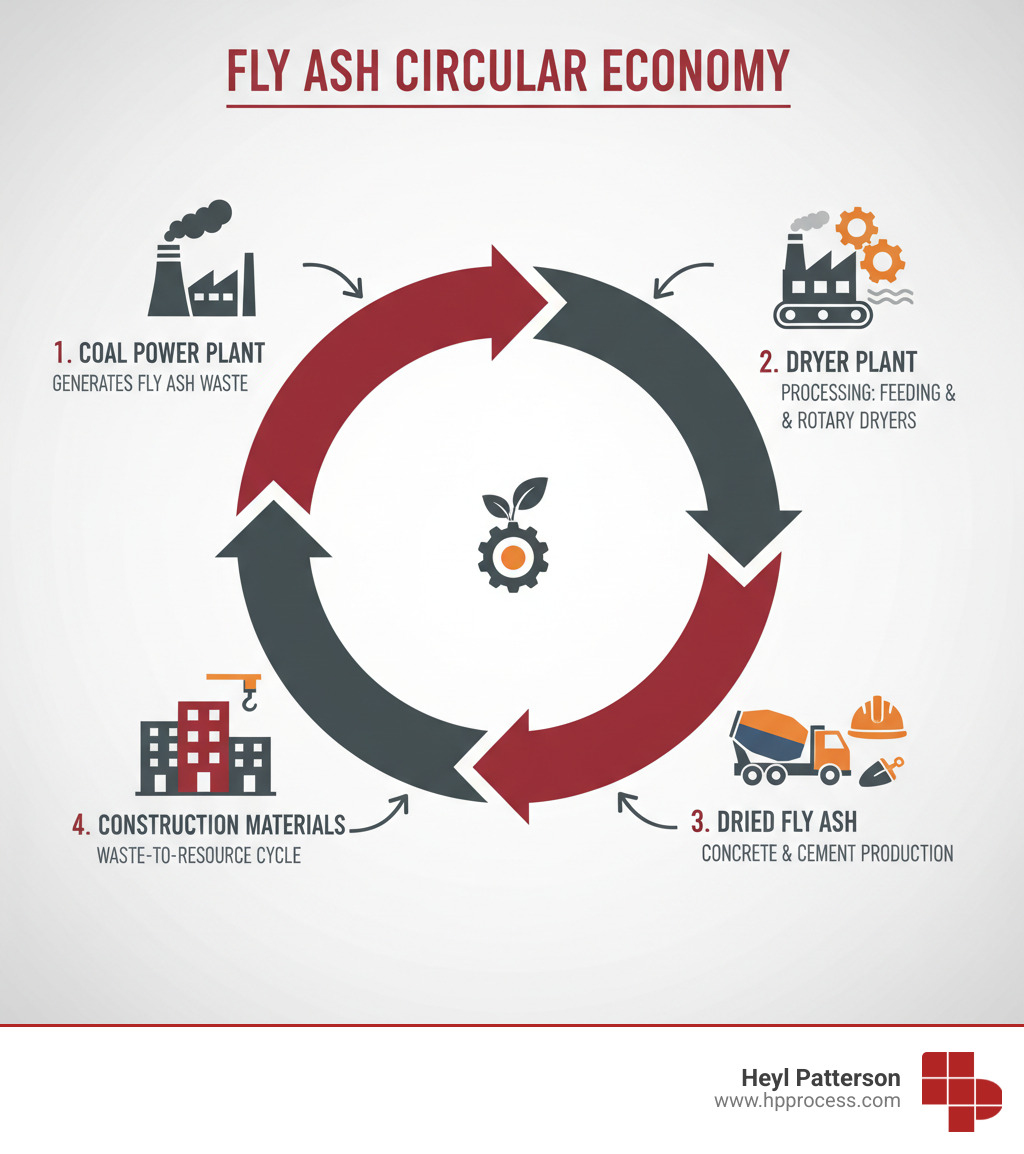
The environmental benefits are clear. Diverting fly ash from landfills conserves natural resources and prevents potential groundwater contamination. This circular economy approach transforms waste into valuable products.
For power plant operators, this means a shift from disposal costs to revenue streams. Instead of paying landfill fees, they can sell dried fly ash to industrial users. Learn more in our guide on Fly Ash: A Substitute for Cement.
As global construction demand rises, dried fly ash offers a path to meet infrastructure needs sustainably. This makes fly ash dryer plant technology a crucial component of sustainable development. Find out more about the environmental advantages in our article Going Green with Coal Fly Ash.
Anatomy of a High-Performance Fly Ash Dryer Plant
A modern fly ash dryer plant operates on a simple principle: remove moisture from industrial waste efficiently and consistently to create a valuable construction material. The core working principle is direct contact heat exchange. Wet fly ash enters a heated environment where hot gases make direct contact with the particles. As the material tumbles or flows through, moisture evaporates and is carried away by the exhaust stream. Our dryers feature specially engineered heat exchanger technology to ensure even material distribution and optimal heat transfer.
Key components work together to achieve this. The typical feeding system uses hoppers and belt conveyors, often with aeration and vibrators to handle sticky wet ash. The drying drum or chamber is where the change occurs, with operating temperatures from 200°C to 600°C. A heat source (coal, biomass, or natural gas) generates consistent heat, while the discharge system moves the dried product via conveyors.
Robust dust collection systems are essential for environmental compliance and product recovery. Our systems combine cyclone separators with high-efficiency baghouse filters to capture even the finest particles, ensuring clean operation. For a broader perspective, see our Guide to Drying Technologies: Which One Suits Your Needs?
Common Dryer Types for Fly Ash Processing
Choosing the right dryer is critical. Heyl Patterson offers several types, each with unique advantages.
Rotary dryers are the workhorses of the industry. A large, rotating cylinder on a slight incline tumbles material through a hot gas stream. Internal flights lift and shower the fly ash, creating excellent heat transfer. They handle large capacities and varying moisture content, making them ideal for continuous, heavy-duty operation. Learn more about our Rotary Dryers & Coolers.
Fluid bed dryers offer precision and efficiency. Hot air flows up through a perforated plate, creating a “boiling” bed of fly ash. This fluidization ensures incredible contact between air and particles for rapid, uniform drying and excellent temperature control. For comparisons, see Fluid Bed Dryers vs. Rotary Dryers: Which is Best for Your Application?.
Flash dryers are built for speed. These pneumatic systems disperse wet fly ash into a high-velocity hot gas stream, where moisture flashes off almost instantly. With residence times of just a few seconds, they have a compact footprint and are effective for fine, free-flowing materials. Explore our Flash Dryers & Coolers.
| Feature | Rotary Dryers | Fluid Bed Dryers | Flash Dryers |
|---|---|---|---|
| Capacity | High to Very High | Medium to High | Low to Medium |
| Moisture Range | Wide (high initial, low final) | Medium to Low initial, very low final | Low to Medium initial, very low final |
| Footprint | Large | Medium | Small, vertical |
| Efficiency | Good (70-85% thermal efficiency) | Excellent (high thermal efficiency) | Good (rapid heat transfer) |
| Material Type | Versatile, can handle sticky materials | Granular, fine, free-flowing particles | Fine, light, free-flowing particles |
| Control | Good | Excellent (uniform drying) | Limited (very short residence time) |
The right choice depends on your material characteristics, capacity, space, and budget. Our engineering team matches the perfect dryer technology to your needs.
Designing Your System: Selection and Operational Parameters
Choosing the right fly ash dryer plant requires a custom approach, not a cookie-cutter solution. We work with you to design a system that fits your specific needs.
Key Selection Factors:
- Moisture Content: The initial and target moisture levels (e.g., from 20% down to <1%) determine the dryer’s workload and type.
- Material Characteristics: Particle size, abrasiveness, and stickiness influence the design and materials of construction.
- Required Capacity: We size the system to meet your throughput goals, from 10 to 65 tons per hour or more.
- Site & Utilities: Available space, foundation support, electricity, and fuel preferences shape the system design.
To eliminate guesswork, we recommend material testing. We process samples of your fly ash in our state-of-the-art testing facility to validate equipment selection and give you confidence in your investment. Learn more about How Product Testing Labs Reduce Risk and Improve ROI in Thermal Processing Projects.
Typical Operational Parameters:
Your plant will operate within optimized parameters:
- Temperature: Typically 200°C to 600°C, balanced for efficient drying without damaging the material.
- Capacity: Sized to match your production goals without over-engineering.
- Power Consumption: Our advanced systems can reduce power usage by up to 60% compared to older alternatives.
- Thermal Efficiency: Our dryers achieve 70% to 85% thermal efficiency, lowering operating costs.
Available Heat Sources:
Our systems offer fuel flexibility:
- Coal-fired furnaces are efficient and cost-effective where coal is available.
- Biomass burners use renewable materials like agricultural waste or wood pellets for a greener alternative.
- Natural gas provides clean combustion and precise temperature control.
- Waste heat from other industrial processes offers the ultimate in efficiency, dramatically reducing operating costs.
Our team helps you select the ideal heat source based on fuel availability, cost, and regulations for your fly ash dryer plant.
Optimizing Operations and Maintenance
Even the best fly ash dryer plant needs careful maintenance to run smoothly and prevent costly problems. Here are key areas to focus on.
Common Operational Challenges & Solutions
- Material Blockage: Wet fly ash can stick at various points in the drying system causing the process to shut-down. Solution: Control feed moisture through pre-treatment (dewatering) and design the drying system to reduce the risk of sticking in the affected areas.
- Premature Wear: Fly ash is a very abrasive material that can cause significant equipment wear in a very short period of time. Solution: Employ robust materials of construction to areas that are prone to wear as well as incorporate replaceable wear components in high impact areas.
- High Dust Emissions: Fine particles can escape collection systems, causing compliance issues. Solution: Provide cyclones and baghouses that are well equipped with dust detection instrumentation, robust gasketing, and strategic access points while maximizing collection of valuable product.
Impact of Climate
Weather affects dryer performance. Cold ambient temperatures increase heat loss, while high humidity slows the drying rate. To mitigate this, add insulation to the dryer’s outer shell and consider a closed environment for operations in high-humidity climates.
Safety Considerations
Protecting your team and investment is paramount.
- Dust Control: Essential for for creating a safe environment for plant personnel. Your collection system is a key safety feature.
- High-Temperature Protection: Use robust insulation and guarding around hot surfaces, and implement temperature monitoring with emergency shutdowns.
- Equipment Guarding: Ensure all moving parts (drums, conveyors) are properly guarded to prevent accidents. For more, see How Proper Equipment Increases Safety in Drying Coal Ash Reuse.
A Preventive Maintenance Guide for Your Fly Ash Dryer Plant
Proactive maintenance prevents disasters. Follow a structured plan:
- Scheduled Inspections: Routinely check all critical components (motors, drums, fans) for noise, vibration, and wear.
- Lubrication: Adhere to the manufacturer’s lubrication schedule for all moving parts to reduce friction and wear.
- Component Wear Checks: Promptly replace worn parts like linings, seals, and conveyor belts.
- Recordkeeping: Document all inspections, repairs, and adjustments to spot trends and optimize your maintenance strategy. Our Guide to Preventive Maintenance for Dryers and guide on Recordkeeping: Effective Dryer Maintenance offer best practices.
How to Increase the Output of a Fly Ash Dryer Plant
Boost productivity with these strategies:
- Increase Heat: Raise the temperature within safe limits (200°C – 600°C) to accelerate drying rate.
- Optimize Feed Rate: Find the balance where material has complete contact with hot air without overwhelming the system.
- Increase Air Flow: Faster airflow carries moisture away more effectively.
- Use Pre-treatment: Mechanical dewatering or preheating reduces the initial moisture load, boosting capacity and efficiency.
Conclusion: Partnering for a Sustainable and Profitable Future
Fly ash dryer plants are key to turning coal combustion waste from an environmental headache into a profitable, planet-friendly construction material. By drying fly ash, it can replace up to 30% of Portland cement, reducing the carbon footprint of an industry responsible for 7% of global CO2 emissions and creating stronger, more durable concrete.
The role of drying in opening this potential is critical. The right technology whether a robust rotary dryer, an efficient fluid bed system, or a rapid flash dryer transforms unusable ash into a valuable, free-flowing material.
The future outlook is bright. As the construction industry accepts sustainable materials and circular economy principles, the demand for quality fly ash is climbing. Investing in efficient processing today positions companies for tomorrow’s opportunities.
At Heyl Patterson, we have perfected thermal processing for decades. Our state-of-the-art product testing laboratory allows us to analyze your fly ash and design a system without guesswork. We deliver custom-engineered thermal processing solutions that work as promised from day one, with thermal efficiencies of 70-85% to minimize energy costs and maximize output.
Ready to turn your fly ash challenge into a profitable opportunity? We partner with you every step of the way, from initial testing to installation and ongoing support, to build a fly ash dryer plant that delivers lasting results.
Explore our advanced solutions for the Coal Fly Ash industry and find how Heyl Patterson can help you create a more sustainable and profitable future.
Last updated on February 9th, 2026 at 05:23 pm