
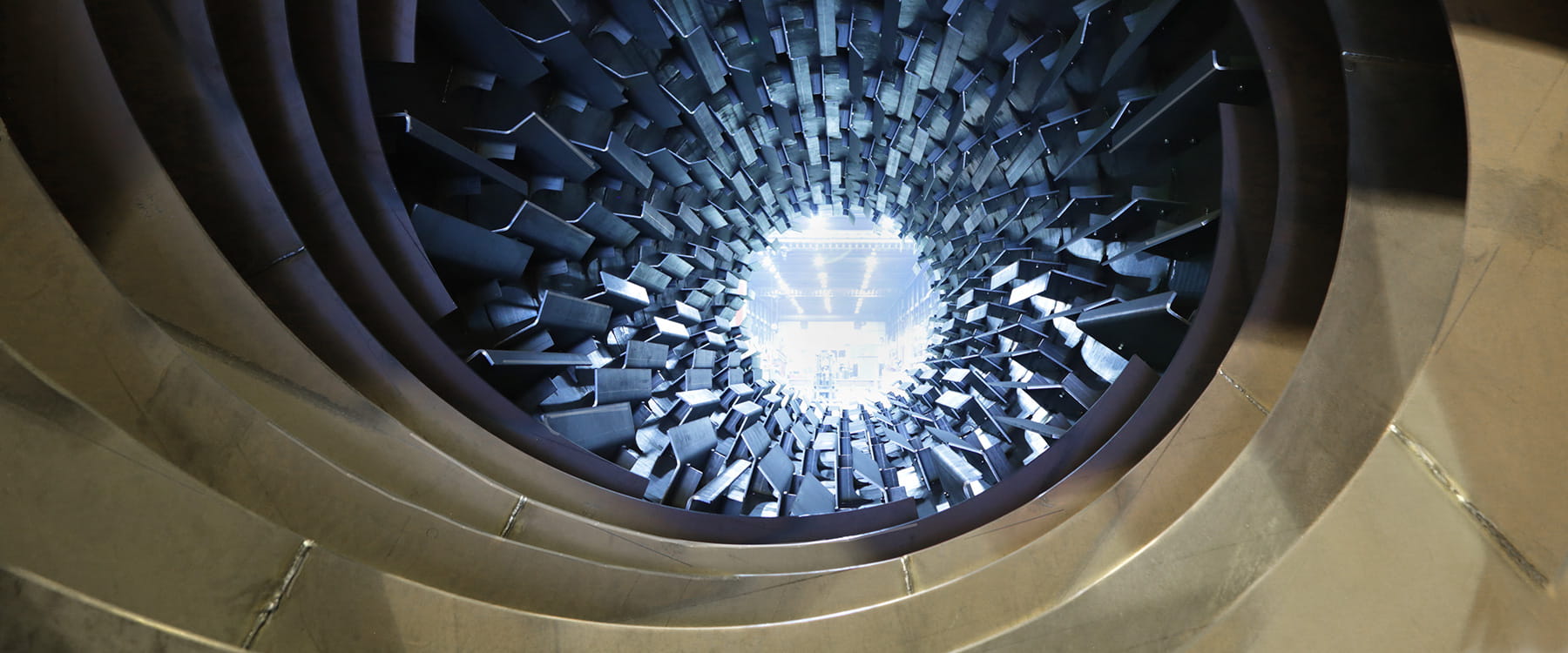
Rotary Dryers & Coolers
Heyl Patterson Thermal Processing Rotary Dryers and Coolers are some of the most versatile rotary dryers and coolers available and are considered the workhorses of the powder and bulk solids processing industry. Able to effectively handle a broad range of materials, including powder and bulk solids and liquid sludges, the Rotary Dryer can be specified according to starting and final moisture content, product temperature, drying air temperature, air velocity, and retention time of the material – to meet and exceed your specific application requirements. Based upon your needs, several different cooling design options are also available, including counter-current air swept, internal and external water-cooled or a combination of air and water-cooled.
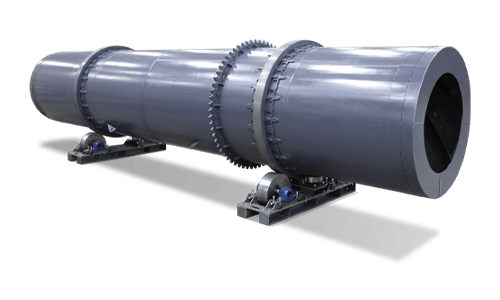
Our Rotary Dryers can be direct-fired with natural gas, LPG, fuel oils, or coal and indirectly heated using steam. Waste heat sources such as furnace exhaust or boiler flue gas can also be utilized, providing versatility based on resources.
Features & Benefits
- Adjustable retention time for precise temperature and moisture control.
- Versatile, highly efficient, low-energy use design for accelerated processing without product degradation.
- Air-cooled designs process non-dusty granular or crystalline materials.
- High-capacity design accommodates difficult-to-handle materials and variations in feed surges with little flow resistance.
- Full penetration shell welds, shell alternating seam welds, continuous flighting welds, solid steel tire, trunnion, and thrust rollers for low abrasion wear on rotating components and long-lasting durability.
- Fly Ash Beneficication
- Hemp & Biomass
- Paper Pulp
- Fertilizers
- Industrial Minerals
- Inorganic Chemicals
- Carbon Fiber
Heyl Patterson designs rotary agglomerator granulators to process powder and bulk materials into spherical pellets. Our rotary drum granulator utilizes the rotational element of a horizontal drum mounted at a slight incline to create agglomerates. Custom-designed rotary drums can provide short or long retention times, reaction processes, and controlled particle size through rotation speed and inclination. Agglomerator granulators are ideal for processing calcium chloride, copper ore, gold ore, and zinc sulfate.
Download our Rotary Dryers & Coolers brochure to see more applications.
Spiral & Lifting Flight Design
A variety of lifting flight designs, including straight, saw, gusseted, or completely customized flights, are available to accommodate your application. Alternating 45° and 90° tip flights in all rows provide uniform showering through the shell cross-section, while alternating rows provide uniform showering along the shell length.
This flight design reduces short-circuiting of gas through the shell to maximize drying performance.
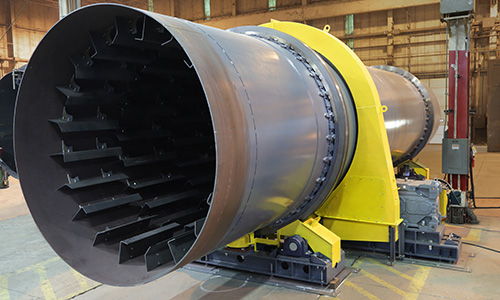
We also offer Fluid Bed Dryers & Coolers and Flash Dryers for various applications.

Specifications for a rotary calciner can be customized to a customer’s particular application, including:
- Sizes up to 16 feet in diameter and in excess of 100 feet in length
- Inlet gas temperatures up to 2200 degrees F (1200 degrees C)
- Co-current and counter-current material/gas flow designs
- Induced-draft, forced-draft, and combination airflow systems
- A variety of control systems are available, from burner management only to complete PLC-based process control
- Lifting flight design based on material testing for the most efficient material movement and drying retention time
Built to your unique specifications, or designed by our engineers to exceed your specific application requirements, each Heyl Patterson Rotary Dryer and Cooler can be rigorously pilot tested at our Innovation Center & Test Lab before the final design is implemented.
Speak to an expert.
Options & Accessories
- Variable speed & inclination
- Custom spiral lifting flights
- Cooling designs
- Air flow systems
- Control systems
Featured Resource
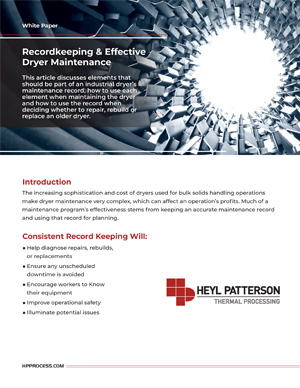
This white paper guide teaches how to develop an effective dryer maintenance program. What to include in an industrial dryer’s maintenance record, how to use each element, and when to repair, rebuild, or replace an older dryer.


