

Calcinadores de lecho fluido
Efficiently process a wide variety of materials with Heyl Patterson’s Fluid Bed Calciners. Our fluid bed calciners are a cost-effective and energy-efficient solution to high-capacity applications where direct contact with the heating medium is acceptable or desirable. Increased mass and heat transfer rates are accomplished with its high surface area contact between the fluid and solid per-unit bed volume.
Características y ventajas
- Menos piezas móviles entran en contacto con el producto, lo que minimiza la degradación.
- Los tiempos de retención variables, que se obtienen variando la profundidad del lecho, proporcionan un control preciso de la temperatura en una amplia variedad de productos.
- Área de contacto extremadamente alta entre el fluido y el sólido por unidad de volumen del lecho.
- Altas velocidades relativas entre el fluido y la fase sólida dispersa.
- Altos niveles de mezcla de la fase particulada.
- Ácido bórico
- Café
- Caolín
- Cerámica
- Sulfato de magnesio
- Minerales metalúrgicos
- Clorato de sodio
Equipo calcinador
La calcinación puede incluir oxidación, reducción, eliminación de agua químicamente ligada u otros tipos de cambios moleculares, cambios en la estructura cristalina o pirólisis que transforma las propiedades físicas o químicas de un material.

Además de los calcinadores de lecho fluidizado, Heyl Patterson ofrece calcinadores rotativos.
Heyl Patterson Thermal Processing cuenta con décadas de experiencia en el diseño y la fabricación de calcinadores de lecho fluidizado y calcinadores de tambor rotativo para una amplia variedad de aplicaciones.
Nuestros calcinadores de lecho fluidizado representan un enfoque especial para el procesamiento térmico. Estos calcinadores procesan materiales en polvo y a granel a temperaturas medias y altas, separándolos completamente de los gases de combustión del horno.
Los ingenieros de Heyl Patterson diseñan cada calcinador de lecho fluidizado a medida para satisfacer los requisitos del producto final deseado.
Fabricados según sus especificaciones únicas o diseñados por nuestros ingenieros para superar los requisitos específicos de su aplicación, cada calcinador Heyl Patterson puede someterse a rigurosas pruebas piloto en nuestro Centro de Innovación y Laboratorio de Pruebas antes de que se implemente el diseño final.
Hable con un experto.
Opciones y accesorios
- Gas natural, GLP o combustibles líquidos.
- Construcción en carbono, acero inoxidable o aleaciones especiales.
- Juntas expandibles y herméticas al polvo para atmósferas especiales

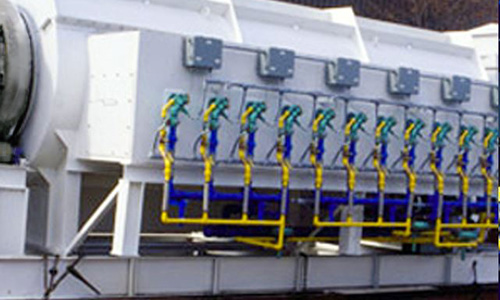
What is a Fluid Bed Calciner?
The Heyl Patterson Fluid Bed Calciner is a direct-contact thermal processing unit that uses upward-flowing gas to suspend fine particles in a fluidized state, enabling high-capacity calcination with uniform temperature distribution and efficient heat transfer. It induces controlled chemical or physical transformations in bulk solid materials, including oxidation, reduction, removal of chemically bound water, crystal structure change, and pyrolysis, in applications where direct contact between the material and the heating medium is acceptable or process-advantageous.
Cómo funciona
The Heyl Patterson Fluid Bed Calciner uses gas-to-particle fluidization to achieve intense, uniform thermal contact across the entire material bed. It is engineered around four integrated principles that work together to give processors precise, high-throughput calcination performance:
Fluidization & Direct Heat Transfer
Process gas is introduced upward through a distributor plate at a velocity calibrated to suspend the particulate material, creating a fluid-like bed where each particle is surrounded and agitated by the gas stream. Because the heating medium contacts the material directly, heat transfer rates are much higher than in indirect systems, and temperature distribution across the bed is highly uniform. This makes fluid bed calcination particularly effective for fine, uniform particle-size materials that require consistent thermal treatment across the entire batch or continuous feed.
Variable Retention Time & Bed Depth Control
Retention time is controlled by adjusting bed depth, which determines how long material remains in the active calcination zone before discharging. This gives operators a precise way to tune the degree of calcination without changing gas temperature or flow rate, allowing the same unit to process a range of materials or product specifications by adjusting a single operating parameter. High intermixing within the fluidized bed further supports uniform processing across all particles, regardless of feed-rate variation.
Atmosphere Management
The fluid bed calciner can be configured with expandable, dust-tight seals to maintain controlled process atmospheres, including inert, oxidizing, or reducing conditions depending on the required reaction chemistry. The gas stream serves as both the fluidizing medium and the reactive or carrier atmosphere, simplifying system design and allowing atmosphere composition to match the specific calcination chemistry of the material being processed.
Minimal Moving Parts & Material Degradation
Because fluidization is achieved entirely through gas flow, few mechanical components contact the product. This reduces wear-related maintenance, minimizes mechanical degradation, and simplifies long-term operation compared to systems that rely on rotating shells or agitator shafts for heat transfer. For fine or fragile materials where particle integrity matters to downstream performance, this is a meaningful design advantage.
Key Benefit
This design suits calcining fine, uniform particle-size materials, including boric acid, kaolin, ceramics, magnesium sulfate, metallurgical ores, and specialty chemical powders, where high heat transfer efficiency, tight temperature uniformity, precise retention time control, and continuous high-capacity processing are critical to consistent final product properties.
Fluid Bed Calciners Product FAQ
What is a fluid bed calciner, and how does it work?
A fluid bed calciner uses upward-flowing gas to suspend fine particles, creating a fluid-like state that enables highly efficient heat transfer and a uniform temperature distribution. This fluidization ensures consistent calcination across all particles, making it ideal for fine or uniform materials.
What materials are best suited for fluid bed calcination?
Fluid bed calciners are best suited for fine, uniform particle-size materials such as chemical powders, alumina, hydrates, and specialty minerals that require precise temperature control and consistent thermal treatment.
How does a fluid bed calciner compare to a rotary calciner?
Fluid bed calciners provide faster heat transfer and tighter temperature uniformity, making them ideal for fine materials and controlled reactions. Rotary calciners, by contrast, are typically better suited for larger particle sizes, variable feedstocks, and materials requiring longer residence times.
What are the advantages of fluid bed calcination?
Key benefits include:
- Uniform temperature distribution across all particles
- High heat transfer efficiency
- Precise control of reaction conditions
- Reduced risk of hot spots or material degradation
- Continuous, high-throughput processing capability
These advantages make fluid bed equipment ideal for processes requiring consistent product quality and tight thermal control.
Can fluid bed calciners be integrated into existing processing lines?
Yes. Fluid bed calciners can be engineered to integrate with upstream and downstream systems, such as drying, material handling, gas treatment, and product cooling, ensuring seamless operation within existing process flows.
Featured Industries
Minería y minerales
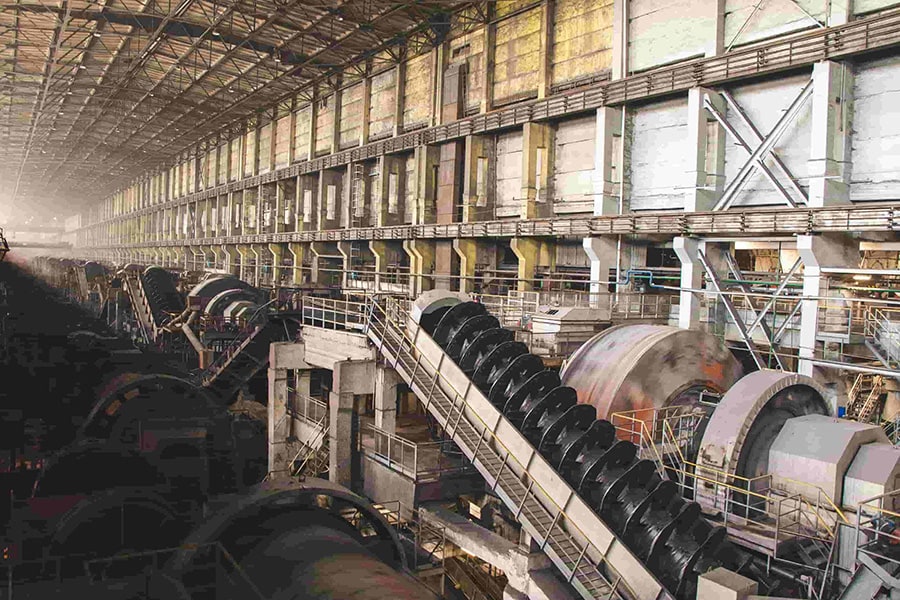
Heyl Patterson fluid bed calciners handle fine, uniform mineral materials requiring consistent high-temperature calcination, with direct gas-to-particle contact delivering efficient heat transfer and tight temperature uniformity across metallurgical ores and specialty mineral applications.
Productos químicos

Fluid bed calciners process specialty chemical powders and granules at medium- to high-temperature conditions, delivering uniform heat distribution and precise retention-time control for oxidation, reduction, and molecular transformation in continuous, high-capacity operations.
Li-Ion Minerals/Batteries

Fluid bed calciners support battery mineral processing with high heat-transfer efficiency and tight temperature uniformity, making them well-suited for fine lithium and precursor materials, where consistent calcination quality directly affects final product performance.