

Secadores y enfriadores de lecho fluido
Heyl Patterson Thermal Processing manufactures some of the largest and most efficient Fluid Bed Dryers in the world for free-flowing materials such as minerals, chemicals, plastics, hemp & wood products, grains, and waste. Materials are suspended in a rising flow of air or gas using an energy-efficient fluidizing method that causes the material to behave like a fluid, thereby enabling high heat transfer rates while gently handling the solids. It also provides lower capital equipment and operating costs due to its efficiency.
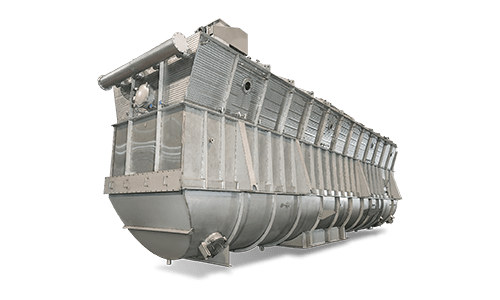
A la hora de seleccionar su secador, se tendrán en cuenta la distribución y densidad del tamaño de las partículas, el contenido de humedad inicial y final, la temperatura del producto y del aire de secado, la velocidad del aire y el tiempo de retención del material.
Características y ventajas
- The fluidizing design maximizes the use of heat from the drying gas steam, achieving high thermal efficiency.
- El diseño cilíndrico proporciona un flujo de mezcla inversa, mientras que el diseño rectangular proporciona un flujo pistón.
- La fluidización completamente neumática sin piezas móviles requiere poco mantenimiento.
- El diseño de medios fluidizados procesa de manera eficiente materiales pegajosos, grumosos o difíciles de manejar.
- Sizes up to 18 feet in diameter, or an equivalent rectangular configuration, for high throughput.
- Inlet gas temperatures up to 2200°F (1200°C).
- Diseño con placa base de acero inoxidable o aleación resistente a altas temperaturas o cúpula de ladrillos refractarios.
- Carbón
- Coca-Cola
- Granos secos de destilería (DDG)
- Minerales metalúrgicos
- Plásticos
- Goma
- Cáñamo y biomasa
Heyl Patterson designs fluid-bed agglomerator granulators for processing powders and bulk solids into spherical pellets. Fluid bed units typically combine drying with particle agglomeration or granulation by spraying the wet feed material onto a bed of seed material.
Diseños de lecho fluidizado
Se ofrece en tres tipos: lecho fluidizado tipo canal, lecho fluidizado tipo circular y vibratorio. Cada unidad puede incorporar un enfriador independiente o integrado para reducir la temperatura del material después del secado.
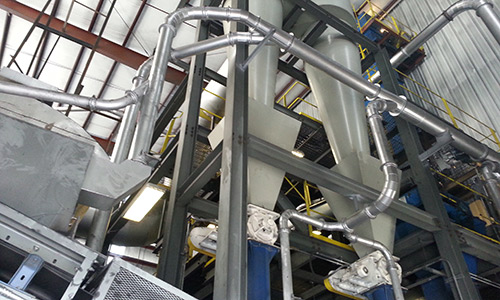
Trough-type employs a first-in/first-out plug-flow method for product handling. Circular-type fluid beds have the advantage of back-mixing processed material with wet or sticky feeds to achieve uniform flow.
We also offer Rotary Dryers & Coolers and Flash Dryers & Coolers for our customers’ other specifications.
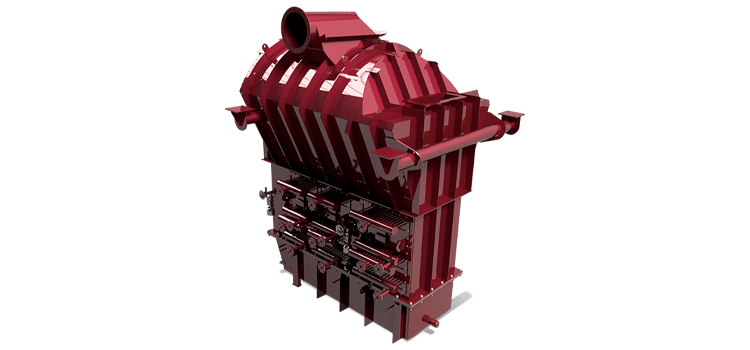
Conventional designs are available for powders and granular materials, as well as specialized designs for materials that are not normally conducive to fluid bed processing, such as sludges, filter cakes, agglomerates, and more.
- Designed as standalone units or in combination with dryers/coolers
- Ocupa poco espacio en comparación con otras tecnologías de secado y enfriamiento.
- Conjuntos de válvulas de quemador totalmente preinstalados y precableados, homologados por la NFPA.
Built to your unique specifications, or designed by our engineers to exceed your specific application requirements, each Fluid Bed Processor can be rigorously pilot-tested at our Innovation Center & Test Lab before the final design is implemented.
Hable con un experto.
Opciones y accesorios
- Secado/enfriamiento combinados
- Through an air-swept design
- Bobinas de placas o tubos en cama
- Diseño de pulverización de agua por evaporación
- Diseños resistentes a la abrasión y la corrosión
- Sistemas de control PLC


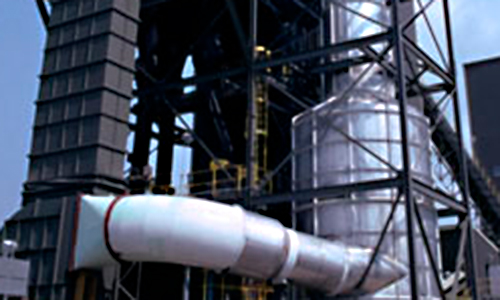
What is a Fluid Bed Dryer & Cooler?
The Heyl Patterson Fluid Bed Dryer and Cooler is a thermal processing unit that suspends bulk solid particles in a controlled upward flow of hot or cool gas, creating a fluidized state where the material behaves like a liquid. Its purpose is to deliver highly efficient, uniform drying or cooling with precise control over moisture content, product temperature, and retention time across a wide range of free-flowing materials.
Cómo funciona
The Heyl Patterson Fluid Bed Dryer and Cooler uses direct contact between process gas and suspended material to achieve intense heat and mass transfer. It is engineered around four integrated principles that work together to give processors efficient, controlled thermal treatment:
Fluidization
Process gas is forced upward through a perforated bedplate at a velocity sufficient to suspend and agitate the material above it. Each particle is individually surrounded by the gas stream, creating direct, continuous contact between the drying or cooling medium and the material. This fluidized state produces heat and mass transfer rates that are significantly higher than those achieved in packed-bed or rotary systems, allowing moisture removal or temperature reduction in a fraction of the time.
Controlled Atmosphere and Temperature
Because the process gas flow, inlet temperature, and bedplate design are all independently controllable, the system can be precisely tuned to match the thermal sensitivity and moisture profile of the material being processed. High inlet gas temperatures are achievable, and the design supports inert, oxidizing, or reducing process atmospheres as required by the application.
Integrated Cooling
A standalone or integral cooler can be incorporated directly into the fluid bed system to reduce product temperature immediately after drying. This eliminates the need for a separate cooling stage, reduces system footprint, and prepares material for safe conveying, storage, or packaging in a single continuous operation.
Key Benefit
This design is well-suited for processing free-flowing granular or particulate materials, including minerals, chemicals, plastics, biomass, grains, and dried distillers grains, where high thermal efficiency, product uniformity, and gentle material handling are critical to process performance.
Fluid Bed Dryers & Coolers FAQs
What is a fluid bed dryer & cooler?
A fluid bed dryer & cooler suspends solid particles in a controlled stream of air or gas, creating a fluidized state where the material behaves like a liquid. This allows for efficient heat transfer and uniform drying or cooling across all particles.
What materials work best in fluid bed dryers & coolers?
Fluid bed dryers & coolers perform best with relatively uniform particle sizes that can fluidize easily. Common materials include chemicals, food ingredients, pharmaceuticals, fertilizers, polymers, and granular minerals.
What are the advantages of fluid bed drying & cooling?
Fluid bed dryers and coolers use a controlled stream of air to suspend and fluidize particles, creating intense contact between the air and the material. This fluidized state allows for highly efficient heat and mass transfer, making the technology well suited for drying and cooling granular or particulate materials.
Can fluid bed systems be used for both drying and cooling?
Yes. Fluid bed systems can be designed for drying, cooling, or both. After drying, the same equipment can be used to cool materials before packaging, storage, or further processing.
How do fluid bed dryers & coolers improve product consistency?
Because each particle is surrounded by the process air during fluidization, heat and moisture removal occur evenly. This minimizes hot spots, prevents uneven drying, and helps maintain consistent product quality.
Featured Industries
Li-Ion Minerals/Batteries

Heyl Patterson fluid bed dryers support lithium and battery mineral processing by providing controlled drying of fine, uniform particle-size materials, including lithium carbonate, hydroxide, and precursor compounds, with precise temperature and retention-time control.
Arena y áridos

Fluid bed dryers deliver high heat and mass transfer rates for free-flowing sand and fine aggregate materials, achieving rapid, uniform moisture reduction with minimal entrainment of fine particles during continuous, high-volume operations.
Fertilizante

Fluid bed dryers and coolers process granular fertilizer materials with high thermal efficiency, delivering uniform moisture removal and controlled product cooling in a compact system footprint suited to continuous fertilizer production lines.