

Calcinateurs à lit fluidisé
Efficiently process a wide variety of materials with Heyl Patterson’s Fluid Bed Calciners. Our fluid bed calciners are a cost-effective and energy-efficient solution to high-capacity applications where direct contact with the heating medium is acceptable or desirable. Increased mass and heat transfer rates are accomplished with its high surface area contact between the fluid and solid per-unit bed volume.
Caractéristiques et avantages
- Moins de pièces mobiles entrent en contact avec le produit, ce qui réduit la dégradation au minimum.
- Les temps de rétention variables obtenus en modifiant la profondeur du lit permettent un contrôle précis de la température sur une grande variété de produits.
- Surface de contact extrêmement élevée entre le fluide et le solide par unité de volume du lit.
- Vitesses relatives élevées entre le fluide et la phase solide dispersée.
- Niveaux élevés de mélange de la phase particulaire.
- Acide borique
- Café
- Kaolin
- Céramique
- Sulfate de magnésium
- Minerais métallurgiques
- Chlorate de sodium
Équipement de calcination
La calcination peut inclure l'oxydation, la réduction, l'élimination de l'eau chimiquement liée ou d'autres types de changements moléculaires, des changements dans la structure cristalline ou la pyrolyse qui transforme les propriétés physiques ou chimiques d'un matériau.

En plus des calcinateurs à lit fluidisé, Heyl Patterson propose des calcinateurs rotatifs.
Heyl Patterson Thermal Processing possède plusieurs décennies d'expérience dans la conception et la fabrication de fours de calcination à lit fluidisé et à tambour rotatif destinés à une grande variété d'applications.
Nos calcinateurs à lit fluidisé représentent une approche particulière du traitement thermique. Ces calcinateurs traitent les poudres et les matériaux en vrac à des températures moyennes à élevées tout en les séparant complètement des gaz de combustion du four.
Les ingénieurs de Heyl Patterson conçoivent chaque calcinateur à lit fluidisé sur mesure afin de répondre aux exigences de votre produit final.
Conçus selon vos spécifications uniques ou par nos ingénieurs pour dépasser les exigences spécifiques de votre application, tous les calcinateurs Heyl Patterson peuvent être soumis à des essais pilotes rigoureux dans notre centre d'innovation et notre laboratoire d'essai avant que la conception finale ne soit mise en œuvre.
Parlez à un expert.
Options et accessoires
- Gaz naturel, GPL ou fiouls
- Construction en carbone, acier inoxydable ou alliages spéciaux
- Joints extensibles et étanches à la poussière pour atmosphères spéciales

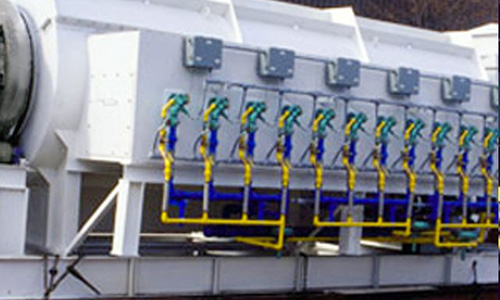
What is a Fluid Bed Calciner?
The Heyl Patterson Fluid Bed Calciner is a direct-contact thermal processing unit that uses upward-flowing gas to suspend fine particles in a fluidized state, enabling high-capacity calcination with uniform temperature distribution and efficient heat transfer. It induces controlled chemical or physical transformations in bulk solid materials, including oxidation, reduction, removal of chemically bound water, crystal structure change, and pyrolysis, in applications where direct contact between the material and the heating medium is acceptable or process-advantageous.
Comment ça marche
The Heyl Patterson Fluid Bed Calciner uses gas-to-particle fluidization to achieve intense, uniform thermal contact across the entire material bed. It is engineered around four integrated principles that work together to give processors precise, high-throughput calcination performance:
Fluidization & Direct Heat Transfer
Process gas is introduced upward through a distributor plate at a velocity calibrated to suspend the particulate material, creating a fluid-like bed where each particle is surrounded and agitated by the gas stream. Because the heating medium contacts the material directly, heat transfer rates are much higher than in indirect systems, and temperature distribution across the bed is highly uniform. This makes fluid bed calcination particularly effective for fine, uniform particle-size materials that require consistent thermal treatment across the entire batch or continuous feed.
Variable Retention Time & Bed Depth Control
Retention time is controlled by adjusting bed depth, which determines how long material remains in the active calcination zone before discharging. This gives operators a precise way to tune the degree of calcination without changing gas temperature or flow rate, allowing the same unit to process a range of materials or product specifications by adjusting a single operating parameter. High intermixing within the fluidized bed further supports uniform processing across all particles, regardless of feed-rate variation.
Atmosphere Management
The fluid bed calciner can be configured with expandable, dust-tight seals to maintain controlled process atmospheres, including inert, oxidizing, or reducing conditions depending on the required reaction chemistry. The gas stream serves as both the fluidizing medium and the reactive or carrier atmosphere, simplifying system design and allowing atmosphere composition to match the specific calcination chemistry of the material being processed.
Minimal Moving Parts & Material Degradation
Because fluidization is achieved entirely through gas flow, few mechanical components contact the product. This reduces wear-related maintenance, minimizes mechanical degradation, and simplifies long-term operation compared to systems that rely on rotating shells or agitator shafts for heat transfer. For fine or fragile materials where particle integrity matters to downstream performance, this is a meaningful design advantage.
Key Benefit
This design suits calcining fine, uniform particle-size materials, including boric acid, kaolin, ceramics, magnesium sulfate, metallurgical ores, and specialty chemical powders, where high heat transfer efficiency, tight temperature uniformity, precise retention time control, and continuous high-capacity processing are critical to consistent final product properties.
Fluid Bed Calciners Product FAQ
What is a fluid bed calciner, and how does it work?
A fluid bed calciner uses upward-flowing gas to suspend fine particles, creating a fluid-like state that enables highly efficient heat transfer and a uniform temperature distribution. This fluidization ensures consistent calcination across all particles, making it ideal for fine or uniform materials.
What materials are best suited for fluid bed calcination?
Fluid bed calciners are best suited for fine, uniform particle-size materials such as chemical powders, alumina, hydrates, and specialty minerals that require precise temperature control and consistent thermal treatment.
How does a fluid bed calciner compare to a rotary calciner?
Fluid bed calciners provide faster heat transfer and tighter temperature uniformity, making them ideal for fine materials and controlled reactions. Rotary calciners, by contrast, are typically better suited for larger particle sizes, variable feedstocks, and materials requiring longer residence times.
What are the advantages of fluid bed calcination?
Key benefits include:
- Uniform temperature distribution across all particles
- High heat transfer efficiency
- Precise control of reaction conditions
- Reduced risk of hot spots or material degradation
- Continuous, high-throughput processing capability
These advantages make fluid bed equipment ideal for processes requiring consistent product quality and tight thermal control.
Can fluid bed calciners be integrated into existing processing lines?
Yes. Fluid bed calciners can be engineered to integrate with upstream and downstream systems, such as drying, material handling, gas treatment, and product cooling, ensuring seamless operation within existing process flows.
Featured Industries
Exploitation minière et minéraux
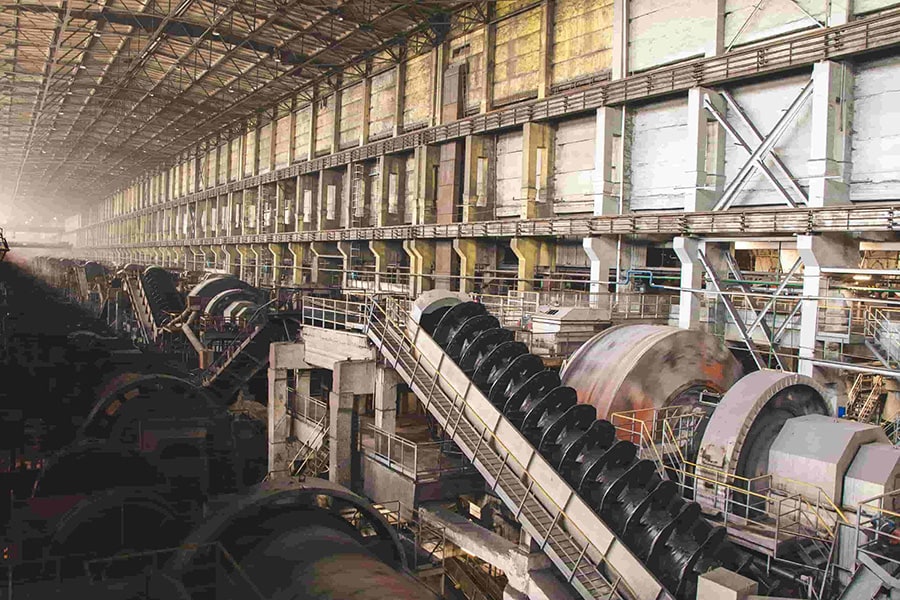
Heyl Patterson fluid bed calciners handle fine, uniform mineral materials requiring consistent high-temperature calcination, with direct gas-to-particle contact delivering efficient heat transfer and tight temperature uniformity across metallurgical ores and specialty mineral applications.
Produits chimiques

Fluid bed calciners process specialty chemical powders and granules at medium- to high-temperature conditions, delivering uniform heat distribution and precise retention-time control for oxidation, reduction, and molecular transformation in continuous, high-capacity operations.
Li-Ion Minerals/Batteries

Fluid bed calciners support battery mineral processing with high heat-transfer efficiency and tight temperature uniformity, making them well-suited for fine lithium and precursor materials, where consistent calcination quality directly affects final product performance.