

Processeurs thermiques MultiDisc
Le processeur thermique MultiDisc de Heyl Patterson est une unité de traitement à basse ou moyenne température qui utilise une méthode innovante de transfert de chaleur par conduction-convection pour sécher et/ou refroidir indirectement des solides en vrac, notamment des minéraux, des produits chimiques, des pigments, des terres et des boues. Le traitement indirect offre des avantages significatifs, tels qu'un rapport produit/surface plus élevé, un rendement thermique très élevé et des volumes de gaz d'échappement minimaux nécessitant moins d'équipements coûteux de contrôle de la pollution atmosphérique. Notre processeur thermique MultiDisc présente une conception innovante qui réduit encore davantage l'encrassement de surface, le colmatage et la consommation d'énergie, ce qui permet de réduire efficacement vos coûts d'exploitation globaux.
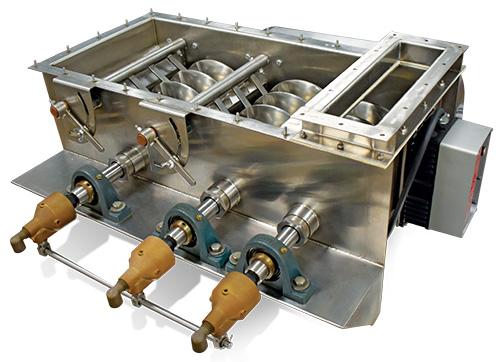
Configurable avec des disques maillés, des disques non maillés ou une combinaison des deux. Les disques maillés offrent un mélange amélioré pour les solides humides difficiles à transporter ou ceux qui adhèrent aux surfaces chaudes et sont idéaux pour le traitement par lots où un contrôle uniforme de la température est nécessaire.
Caractéristiques et avantages
- Le rapport produit/surface élevé améliore l'efficacité du transfert thermique.
- Le traitement indirect produit des volumes minimaux de gaz d'échappement.
- La conception polyvalente permet aux fluides caloporteurs de circuler selon des schémas d'écoulement parallèles.
- Les barres de transport inclinées éliminent le passage ou le court-circuitement des parois latérales.
- Sa taille compacte offre une capacité de traitement totale dans un encombrement qui pourrait à peine accueillir le groupe motopropulseur de processeurs thermiques similaires.
- Agriculture / Céréales
- Gypse
- Produits chimiques organiques
- Céramique
- Charbon
- Métaux
- Pigments
- Polyester
- Carbonate de sodium
- Exploitation minière et minéraux
Les processeurs thermiques MultiDisc de Heyl Patterson sont recommandés pour d'innombrables applications de séchage, de chauffage et de refroidissement. Téléchargez notre brochure sur les processeurs thermiques MultiDisc pour découvrir d'autres applications.
Rapport élevé entre surface et volume traités
Conception d'un ensemble disque creux et arbre
Plusieurs disques sont fixés de manière permanente à l'arbre afin de créer une unité fixe, étanche et autonome. L'eau de refroidissement, la vapeur, le fluide thermique ou les réfrigérants circulent à travers l'ensemble creux, transférant la chaleur ou l'action de refroidissement aux surfaces des disques en rotation.

Le produit circule entre et autour des disques dans la auge et, par conséquent, est exposé à une très grande surface de disques dans un conteneur relativement petit, ce qui améliore l'efficacité.
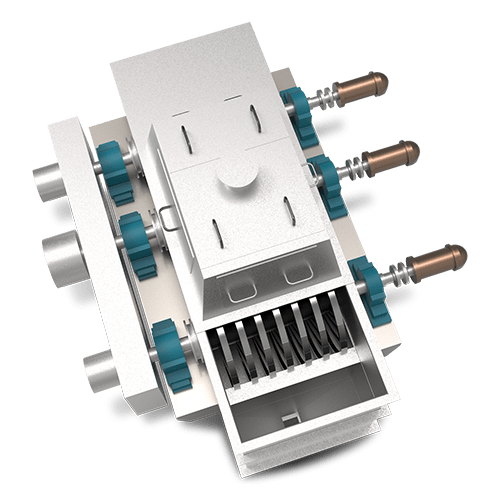
Le chauffage indirect offre un rapport produit/surface plus élevé pour une meilleure efficacité thermique. Il utilise un volume minimal de gaz d'échappement, ce qui nécessite moins d'équipements coûteux de contrôle de la pollution atmosphérique ou de systèmes de récupération des composés volatils. Il permet de maintenir des atmosphères de traitement inertes, oxydantes, réductrices et déshumidifiantes. De plus, les matériaux fins sont facilement traités sans entraînement excessif du produit dans le flux gazeux.
Conçus selon vos spécifications uniques ou par nos ingénieurs pour dépasser les exigences spécifiques de votre application, chaque MultiDisc Heyl Patterson peut être rigoureusement testé dans notre centre d'innovation et notre laboratoire d'essai avant que la conception finale ne soit mise en œuvre.
Parlez à un expert.
Options et accessoires
- Ensembles de disques maillés ou non maillés
- Systèmes à vapeur, à transfert thermique, à fluide ou à énergie électrique
- Systèmes de circulation
- Clips d'agitation et barres de rupture
- Élément chauffant électrique
- Systèmes de contrôle
Téléchargements

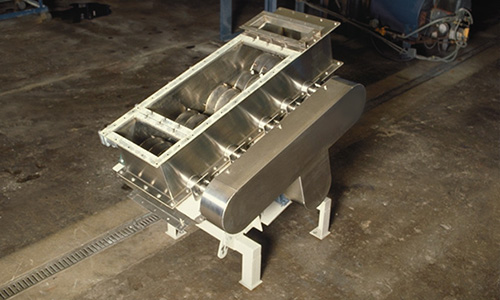
What is a MultiDisc Thermal Processor?
The Heyl Patterson MultiDisc Thermal Processor is an indirect, low- to medium-temperature processing unit that uses a combination of conduction and convection heat transfer to dry, heat, or cool bulk solids. It delivers precise, energy-efficient thermal treatment in a compact footprint, making it well-suited for materials that cannot tolerate direct contact with a heat source or where minimizing exhaust gas volume is a process or environmental priority.
Comment ça marche
The Heyl Patterson MultiDisc Thermal Processor uses a hollow disc-and-shaft assembly to transfer thermal energy indirectly to the material moving through the trough. It is engineered around four integrated principles that work together to give processors controlled, efficient thermal treatment across a wide range of bulk solid materials:
Ensemble disque creux et arbre
Multiple hollow discs are permanently attached to a hollow rotating shaft, forming a single sealed, self-contained assembly. A heat transfer medium, either steam, thermal fluid, hot water, chilled fluid, or electric heating elements, circulates through the shaft and into the discs, transferring thermal energy directly to the rotating disc surfaces. Because the heat source is fully contained within the assembly and never contacts the product directly, the system achieves true indirect processing with no combustion gases introduced into the material stream.
High Surface Area to Volume Ratio
As material flows through the trough, it moves between and around the rotating disc surfaces, exposing each particle to a large amount of heated or cooled surface area within a relatively small vessel. This geometry is the MultiDisc design’s core efficiency advantage: it packs significantly more heat-transfer surface area into a given footprint than conventional jacketed or single-shaft processors. The result is faster thermal treatment at lower operating temperatures, with less energy consumed per unit of material processed.
Controlled Material Flow & Mixing
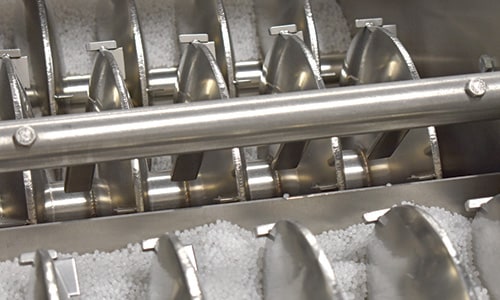
Angled conveying bars move material through the trough in a controlled pattern, preventing short-circuiting or bypassing along the sidewalls. For sticky, cohesive, or surface-fouling materials, meshed disc configurations provide enhanced mechanical mixing that breaks up agglomerates and keeps material in consistent contact with the disc surfaces. You can add agitation clips and breaker bars where you need additional mechanical action. This flexibility in disc configuration allows the same basic design to handle materials ranging from free-flowing granules to wet filter cakes and sludges.
Atmosphere & Exhaust Control
Because processing occurs indirectly, exhaust gas volume is minimal compared to direct-fired systems. The enclosed trough can maintain inert, oxidizing, reducing, or dehumidifying process atmospheres depending on the material requirements, and the low exhaust volumes simplify or reduce the cost of downstream air pollution control and volatile recovery systems. This makes the MultiDisc particularly well-suited for processing chemicals, pigments, and other materials where atmospheric control or emissions management is a design constraint.
Key Benefit
This design is well-suited for drying, heating, or cooling bulk solids including minerals, chemicals, pigments, agricultural products, gypsum, soda ash, and industrial sludges, where precise temperature control, minimal exhaust gas generation, indirect heat transfer, and a compact system footprint are critical to process performance and operating economics.
Processors (MultiDisc & Specialized Systems) FAQs
What materials are best suited for MultiDisc thermal processors?
MultiDisc processors excel with bulk solids that benefit from indirect conduction/convection heat transfer, including chemicals, minerals, agglomerates, and heat-sensitive products.
How does a MultiDisc processor differ from a traditional rotary dryer?
MultiDisc processors use stacked discs to increase surface area for heat transfer without moving belts or screws, enabling more compact designs and tighter temperature control.
Can these processors handle sticky or cohesive materials?
Yes, configurations with meshed discs or gentle agitation promote uniform heat transfer and prevent buildup in sticky or challenging materials.
Are MultiDisc processors suitable for both drying and cooling?
Yes, depending on the configuration and heat-transfer medium (steam, thermal fluid, electricity, chilled fluid), processors can be optimized for either drying or cooling.
What operational benefits do these systems provide?
Advantages include lower exhaust-gas volumes, lower air-pollution-control costs, a compact footprint, and more responsive temperature control than some conventional dryers.
How do I determine whether a processor is more cost-effective than a traditional dryer for my process?
A process evaluation, including moisture content, temperature goals, and energy cost modeling, will identify where a processor’s conduction/convection design yields savings in energy, footprint, or maintenance.
Featured Industries
Exploitation minière et minéraux
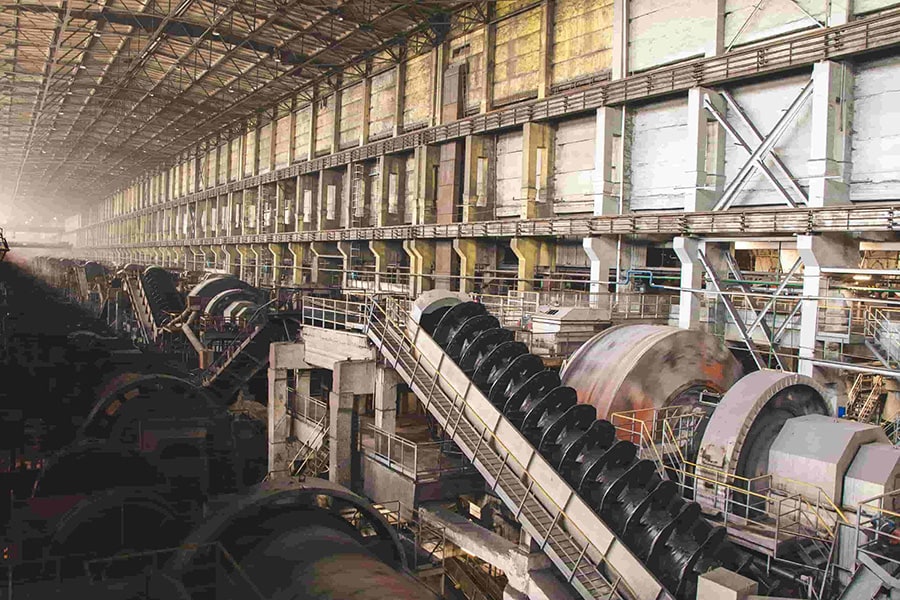
MultiDisc processors handle bulk mineral materials requiring gentle indirect thermal treatment, delivering uniform heating or drying across a wide range of particle sizes with low energy consumption and a compact system footprint.
Traitement chimique

The MultiDisc Thermal Processor dries, heats, or cools specialty chemical materials through indirect conduction, maintaining precise temperature control with minimal exhaust gas generation, making it well-suited for regulated or atmosphere-sensitive chemical processing applications.
Charbon et cendres volantes
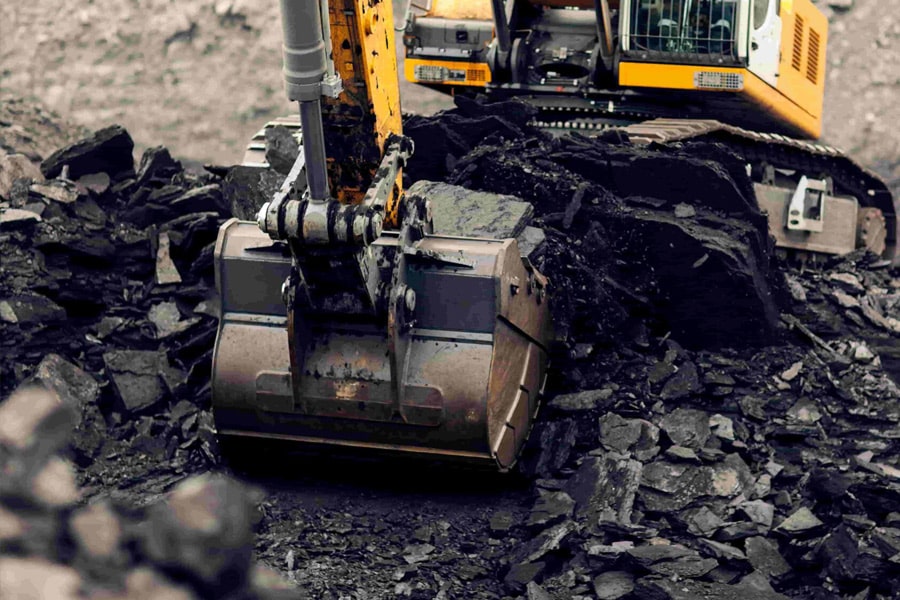
Heyl Patterson MultiDisc processors apply indirect thermal treatment to coal byproducts and fly ash, providing controlled heating or drying with minimal exhaust volume and atmosphere containment suited to regulated industrial processing environments.